
Wilds Unknown, Core, Week One: What the Meta Snapshot Missed
A hand-checked metagame report for the first competitive week of Disney Lorcana Wilds Unknown (Set 12) Core. Full event coverage, why the most-played deck is underperforming, the Set 12 breakout cards, the new Toys / Spike Suit deck, and the rotation cliff coming this fall.

A week-one “metagame” snapshot went around. The raw counts were basically right. What they were called was not. Here is the same week, read from the actual decklists instead of the leaderboard.
A Set 12 week-one meta snapshot made the rounds, and it didn’t sit right. Not because the numbers looked made up. When we pulled the same week, the raw counts came out almost identical. The problem was the label. A pile of week-one results was being called “the metagame,” and the sample was far too thin to carry that word.
So we pulled the whole week and read it properly. This report is what came out the other side.
How to read this report. We deliberately separate what we can prove from what we can only forecast. Confirmed material is built only from decks where we can see the full 60-card list. Directional material uses the win/loss records and the entries that reported a color pair but no list. That second bucket is real, organizer-reported data, but it is a hint about where things are heading, not proof. Every card name was checked by hand against the official Lorcana card data, so nothing here is paraphrased or remembered.
The short version
- Twelve Core events, 258 players, about 60 published decklists. That is roughly a quarter of the field. More than half the field published nothing at all.
- The events don’t measure the same thing. Some are full-roster local leagues, some posted only their top cut, and a few “events” are fragments of a single team-league night.
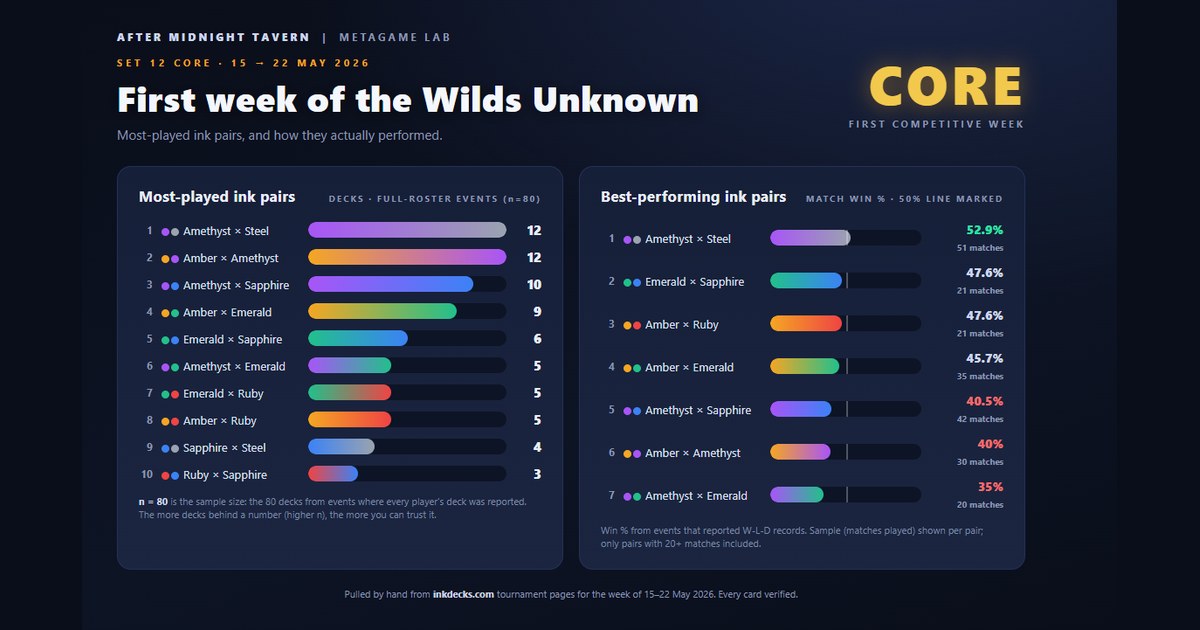
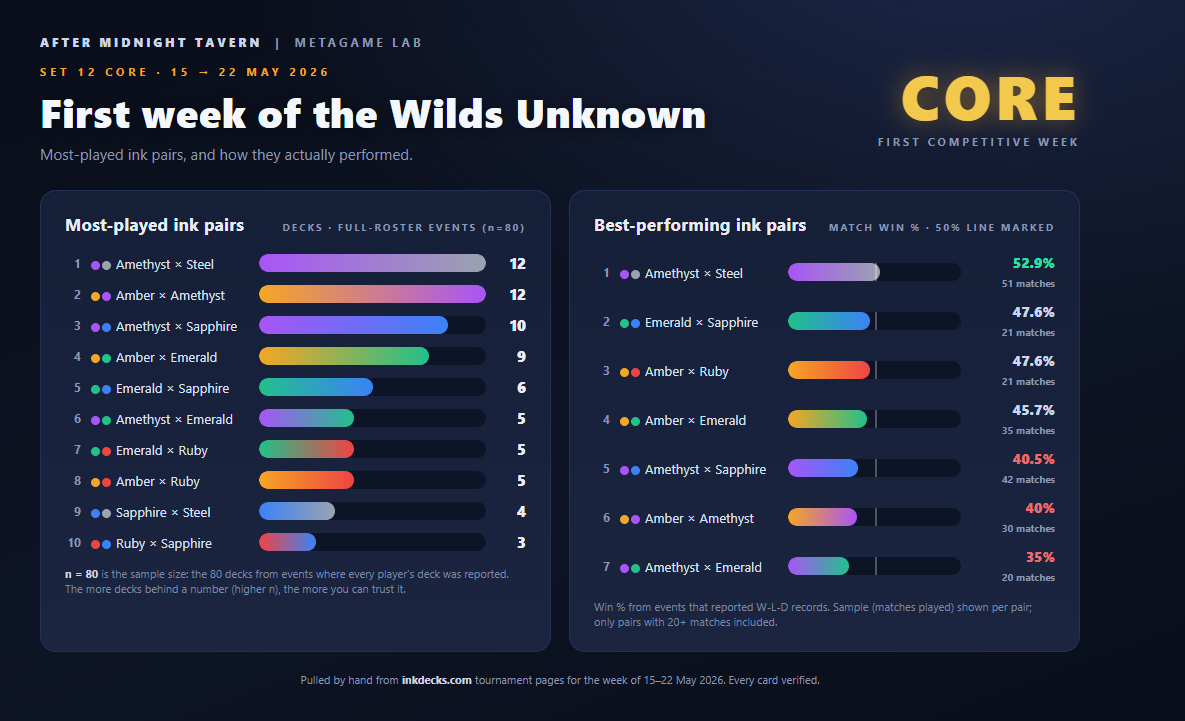
- Popularity is not performance. Once you use the win/loss records, the most-played deck (Amethyst/Sapphire control) sits below the field, while Emerald/Sapphire value-ramp quietly over-performs at nearly 60%.
- Set 12 is barely in the format yet. Every most-played card is an older carryover staple. Only Merryweather — Feisty Fairy is cracking heavy play.
- There is one genuinely new deck: Toys / Spike Suit, built on Dale — Ready for His Shot. It is small, it won its event, and it is 100% rotation-proof.
- The carryover deck winning week one loses its engine this fall at rotation. The new Toys deck doesn’t lose a card.
Coverage: why week one isn’t a metagame yet
Twelve Set 12 Core events fall in the window, with 258 listed players. Here is what each event actually published.
| Event | Date | Players | Color pairs reported | Real card lists |
|---|---|---|---|---|
| Conflux Ink Clash (BE) | 05-16 | 70 | 16 | 16 (top cut only) |
| 2026 Enchanted Duels RECreate (US) | 05-17 | 38 | 8 | 8 (top cut only) |
| Lorcana 6-Case @ Versus Games (US) | 05-16 | 38 | 4 | 1 |
| WU Win-A-Case @ Nexus (US) | 05-16 | 22 | 19 | 0 |
| Heroes Ink: Chapter 12 (DE) | 05-16 | 20 | 20 | 0 |
| WU Case @ Geek Out (US) | 05-16 | 19 | 2 | 2 |
| Battle of Vancouver II (CA) | 05-17 | 14 | 14 | 14 (full roster) |
| Lorcana WU Case @ Refined Gaming (US) | 05-17 | 10 | 1 | 1 (winner only) |
| SET 12 Friendly @ Kinney (KR) | 05-16 | 9 | 9 | 0 |
| Spieltag 6, three divisions (DE) | 05-18 to 05-21 | 18 | 18 | 18 (team league) |
| Total | 258 | 111 (43%) | 60 (23%) |
Two things the snapshot hides:
Coverage splits into two different things. Some events reported every attendee’s color pair but published no card lists at all (Heroes Ink 20 of 20, Nexus 19 of 22, Kinney 9 of 9). Counting those as “decks” is how you inflate the field. Only 60 of the 111 entries are actual 60-card lists.
The data is three incompatible populations stacked together: full-roster local leagues that are a census of small rooms, top-cut-only opens that show you the survivors and not the field, and color-pair-only entries with no list behind them. Aggregating raw counts across those three and calling the result a metagame is the core error.
The clearest tell: one event had 10 players and exactly one posted deck, the winner. On its own page it renders as that color pair being “100% of the metagame.” That is the whole methodology problem in a single screenshot.
Popularity is not performance
The tournament pages carry each deck’s win/loss/draw record. The snapshot ignored them and counted first-place finishes instead, which is the crudest possible use of the data. When you use the records properly, the headline flips.
Here is the color-pair distribution, shown in two honest cuts so the bias is visible. Neither is “the metagame.”
| Color pair | Full-roster census | Real lists only |
|---|---|---|
| Amethyst/Sapphire | 10 | 12 |
| Amethyst/Steel | 12 | 9 |
| Amber/Emerald | 9 | 9 |
| Amber/Amethyst | 12 | 7 |
| Emerald/Sapphire | 6 | 8 |
| Amethyst/Emerald | 5 | 2 |
| Emerald/Ruby | 5 | 3 |
Amethyst is the most-played ink by a clear margin (on 53% of full-roster decks), so the snapshot’s one defensible claim holds: Amethyst is the demand center.
But play volume and results are not the same thing. Pulling the win/loss record off every deck that carried one, the most-played pair is not the best-performing one:
| Color pair (directional) | Match win rate | Matches |
|---|---|---|
| Emerald/Sapphire | 59.5% | 42 |
| Amethyst/Steel | 52.9% | 51 |
| Amber/Ruby | 51.7% | 29 |
| Amethyst/Sapphire (most-played) | 47.6% | 63 |
| Amber/Emerald | 45.7% | 35 |
| Amber/Amethyst | 40.0% | 30 |
| Amethyst/Emerald | 35.0% | 20 |
The most-played deck in the format (Amethyst/Sapphire, the “Blurple” control shell) sits below the field. The quiet over-performer is Emerald/Sapphire value-ramp, near 60%.
Read this as a nudge, not a verdict. Most of those records belong to decks whose lists we can’t fully see, and one event with both full rosters and lists is a single 14-person tournament. So this is a color-pair signal, not a tier list. But the direction is clear: the deck everyone is bringing is not the deck that is winning.
Update, recalibrated against a later event. A larger single Core event (about 99 decks) has since wrapped, and it sharpens this read. What holds: Amethyst/Sapphire is still the most-played pair and still only average, and Emerald/Sapphire is still over-performing near 60%. What does not: the week-one Amethyst/Steel number above (53% on a thin 51-match sample) did not survive contact with the bigger event, where that pair fell to the low 40s. Treat Amethyst/Steel as week-one noise, not a real edge. What is new: Amber-based decks climbed to the top of the bigger event. Amber/Emerald posted the highest win rate and Amber/Amethyst (an evasive-aggro build) was the best converter, while an undefeated 7-0-0 aggro deck took the title. A full week-two write-up will follow once those lists are verifiable card-by-card.
Set 12 is barely in the format yet
Read the 60 real lists and the most-played cards are all carryover. Not one top staple is a Set 12 card.
| Card | Lists (of 60) | Ink / type | First set |
|---|---|---|---|
| Cheshire Cat — Inexplicable | 30 | Amethyst character | S10 |
| Demona — Scourge of the Wyvern Clan | 30 | Amethyst character | S10 |
| Elsa — The Fifth Spirit | 29 | Amethyst character | S5 |
| Hades — Looking for a Deal | 25 | Amethyst character | S10 |
| Sail the Azurite Sea | 24 | Sapphire action | S6 |
| Tipo — Growing Son | 23 | Sapphire character | S5 |
| Dumbo — Ninth Wonder of the Universe | 21 | Amethyst character | S9 |
| Junior Woodchuck Guidebook | 19 | Amethyst item | S10 |
| Genie — Wish Fulfilled | 19 | Amethyst character | S6 |
| Merryweather — Feisty Fairy | 17 | Sapphire character | S12 |
The week-one Set 12 Core field is the pre-existing Amethyst control deck still running the room: Cheshire Cat — Inexplicable as the damage-move engine, Demona — Scourge of the Wyvern Clan as the reset, Elsa — The Fifth Spirit for tempo, Hades — Looking for a Deal for card advantage. Merryweather — Feisty Fairy is the only Set 12 card to crack the top tier of play, and it does so as a sticky Ward body inside that same Sapphire-leaning shell. For now, “the Set 12 metagame” is mostly the Set 11 metagame wearing one new hat.
The breakout cards and the one new deck
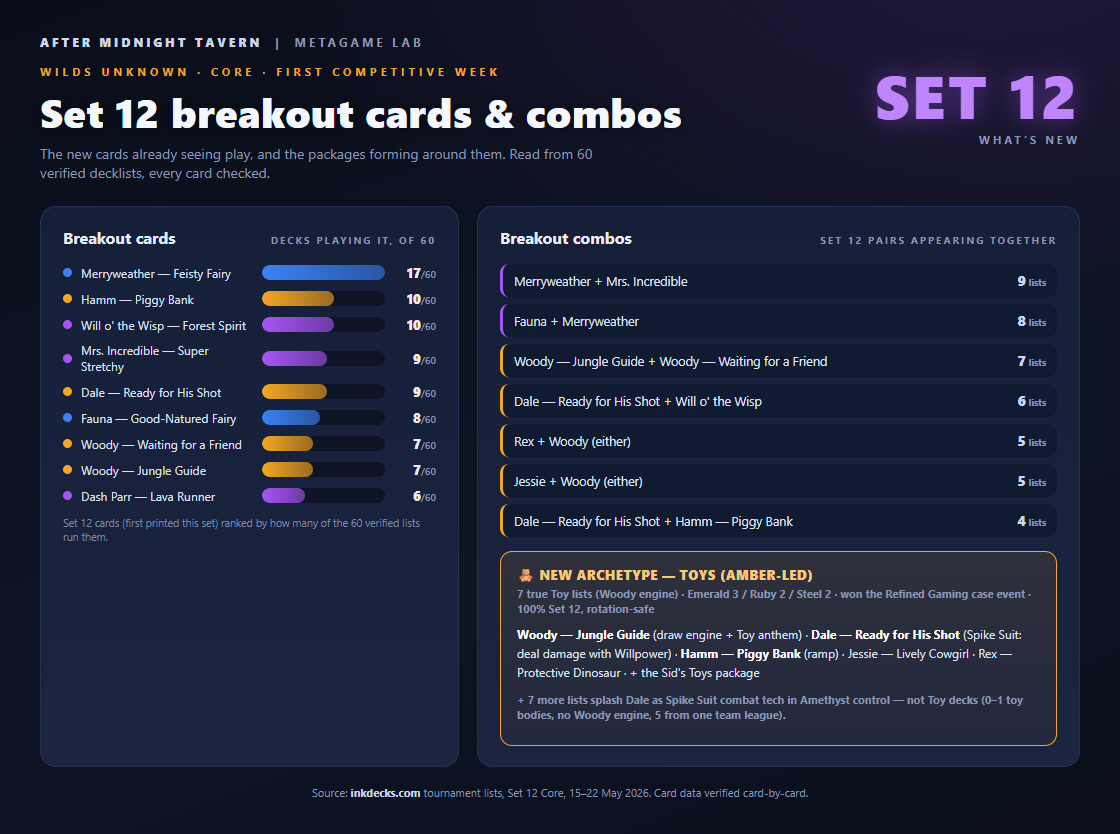
This is the part worth reading closely. The Set 12 cards getting real reps are role-players that upgrade existing shells, plus the seed of something new.
| Set 12 card | Lists (of 60) | Ink / cost | What it does |
|---|---|---|---|
| Merryweather — Feisty Fairy | 17 | Sapphire 4c | Ward body. Sticky blocker and quester for Sapphire control. |
| Hamm — Piggy Bank | 10 | Amber 2c | Exert to pay 1 less for the next character. Toy ramp. |
| Will o’ the Wisp — Forest Spirit | 10 | Amethyst 1c | Returns to hand when banished in a challenge. Resilient early body. |
| Mrs. Incredible — Super Stretchy | 9 | Amethyst 5c | Each turn, gains Evasive or +1 lore. Flexible Super body. |
| Dale — Ready for His Shot | 9 | Amber 4c | Spike Suit: your characters deal damage with Willpower, not Strength. |
| Fauna — Good-Natured Fairy | 8 | Sapphire 1c | Cheap fairy enabler with Support. |
| Woody — Jungle Guide | 7 | Amber 5c | Shift 3. Draws and free-plays a 2-drop on quest, and anthems Toys. |
The adopted cards are upgrades, not new decks: Merryweather — Feisty Fairy and Fauna — Good-Natured Fairy feed Sapphire, Will o’ the Wisp — Forest Spirit and Mrs. Incredible — Super Stretchy slot into Amethyst, Hamm — Piggy Bank is toy ramp. No Set 12 card has created a new top deck in week one.
Except for one thing.
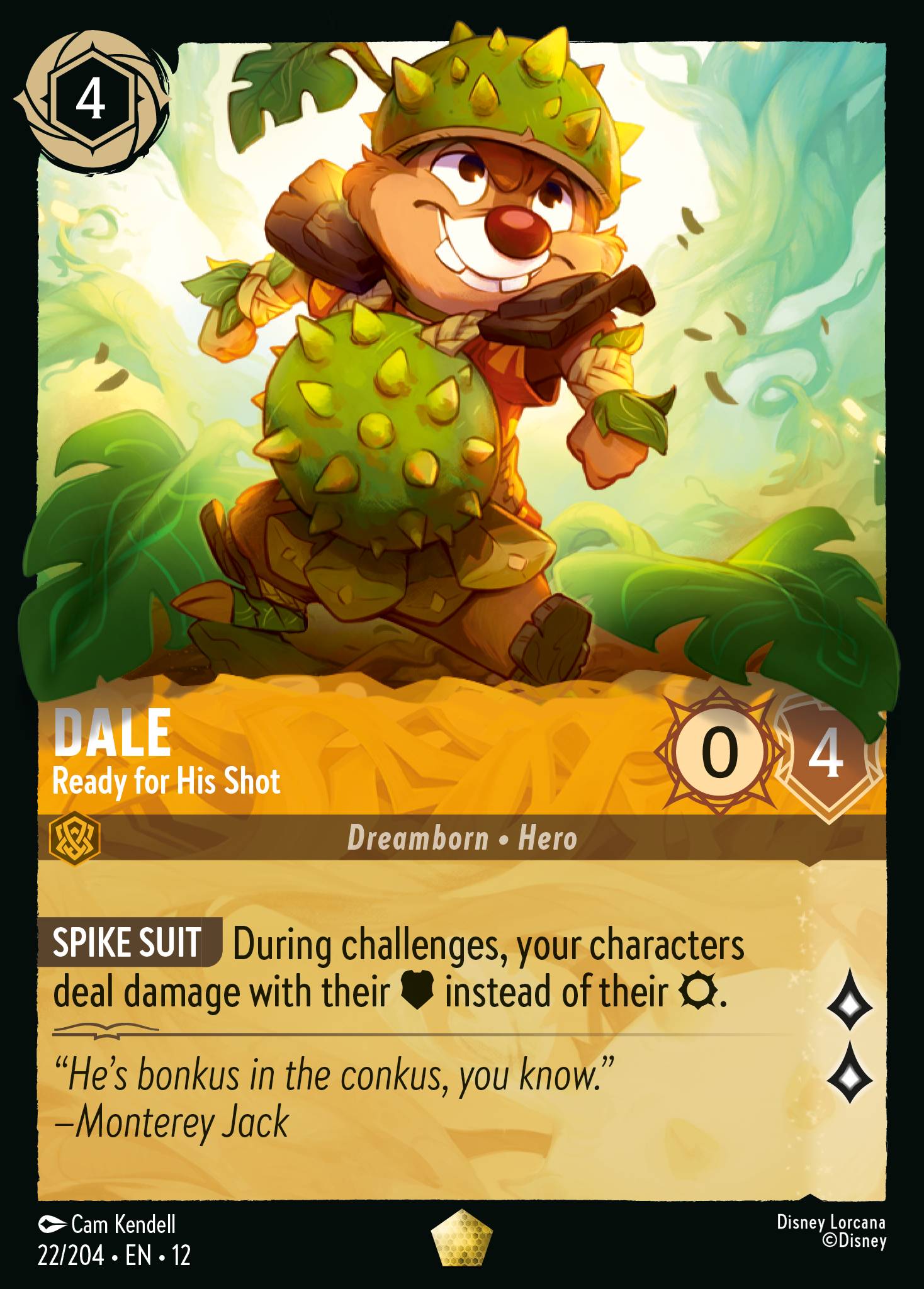
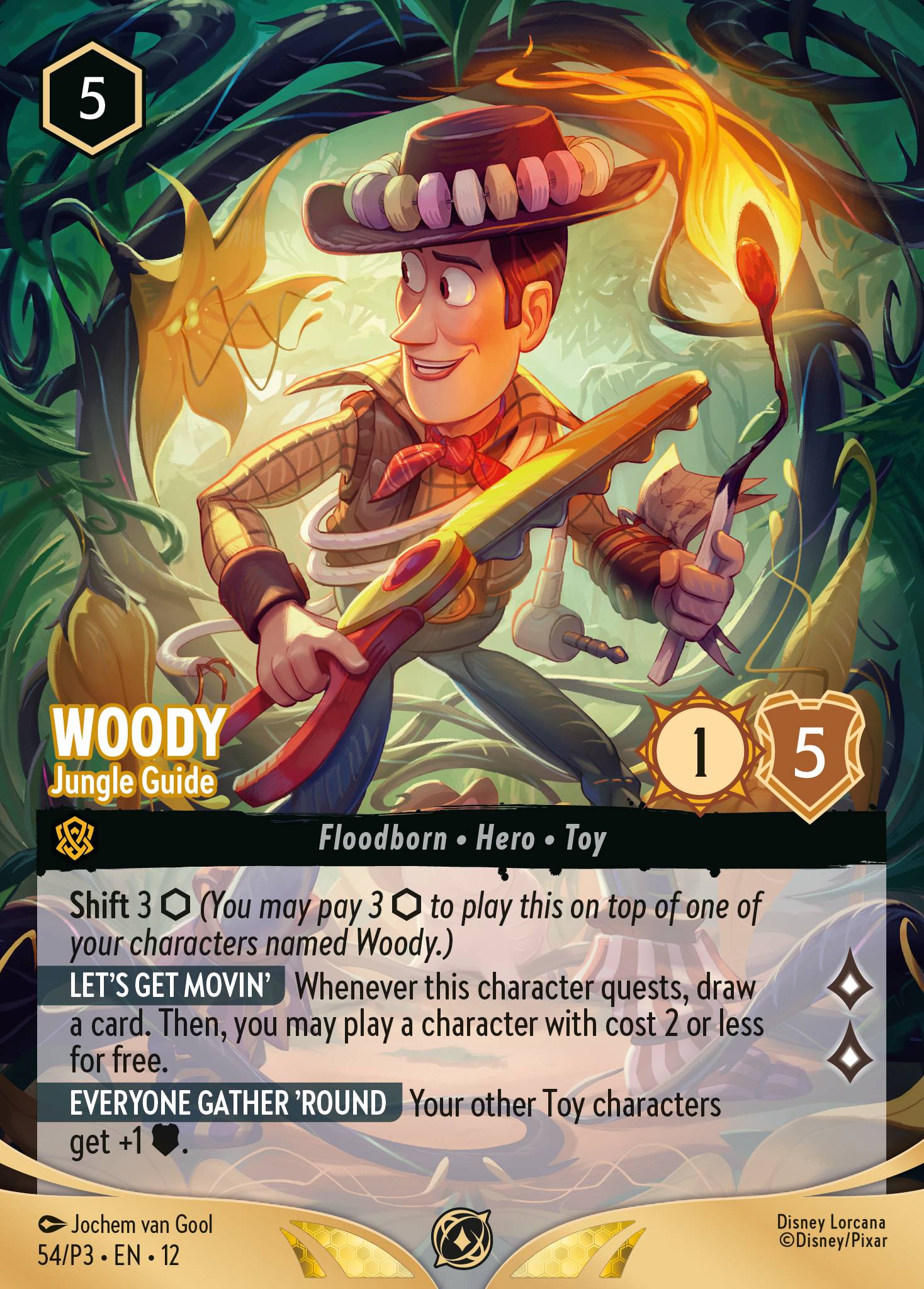
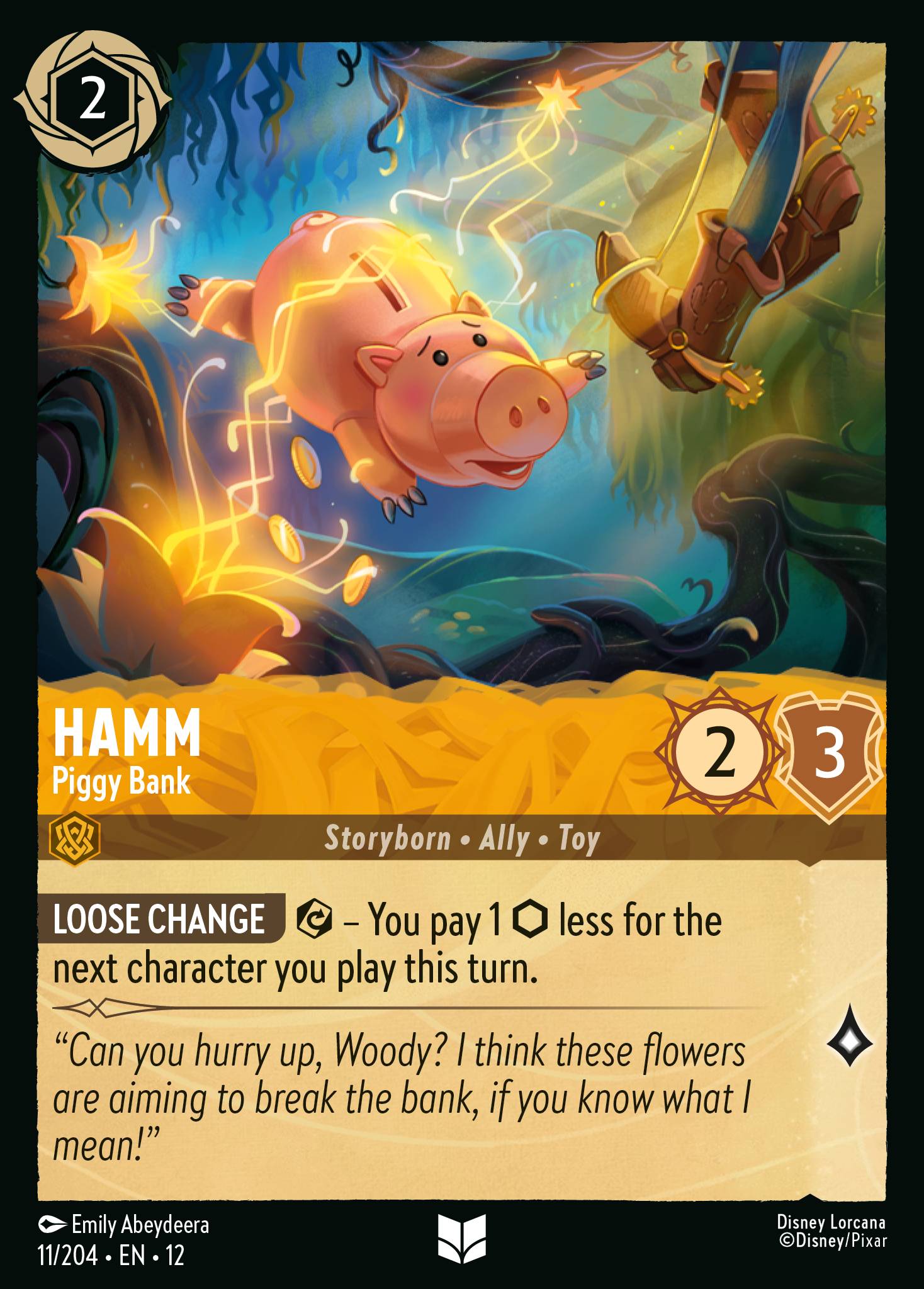
The new archetype to watch is Toys, Amber-led with a second ink for support. The engine is Woody — Jungle Guide: it quests to draw and free-play a 2-drop, and it anthems your other Toys with +1 Willpower. That anthem feeds the deck’s payoff, Dale — Ready for His Shot, whose Spike Suit ability makes your characters deal damage with their Willpower instead of their Strength, which inverts combat math on a board full of buffed high-Willpower Toy bodies. Hamm — Piggy Bank ramps the whole thing out a turn early.
Read the count carefully, because two different decks hide inside it. If you go by what a deck is built to do rather than by declared color pair, 14 of the 60 verified lists run either the Toy engine or the Spike Suit payoff. But those 14 split cleanly in two:
- Seven are true Toy decks built on the Woody — Jungle Guide engine with a real toy body count. These are Amber-led, and the second ink is spread roughly evenly: Amber/Emerald 3, Amber/Ruby 2, Amber/Steel 2. One of them won the Refined Gaming case event outright.
- The other seven are not Toy decks at all. They are Amethyst control and midrange decks splashing Dale — Ready for His Shot as a combat-math tech card. Most run zero or one toy body and no Woody — Jungle Guide, and five of the seven come from a single team league, so they are geographically clustered.
So the genuinely new archetype is the seven-deck Toy build, not a 14-deck wave. It is small, but it is real, it won an event, and it is the first thing in this set that looks like a deck instead of an upgrade. Amber/Emerald is its most natural home (it matches the set’s toy support and the Amber/Emerald toy deck in the Wilds Unknown starter set); Amber/Ruby is the more aggressive, sacrifice-leaning variant. At seven lists the data won’t crown one over the other yet.
The rotation cliff nobody is pricing in
Here is the kicker. The dominant carryover control deck keeps its top end this fall but loses its entire early engine. Sets 5 through 8 rotate out of Core this fall; only cards with a Set 9 or later printing stay legal.
| Rotates out this fall | Lists | Set | What the shell loses |
|---|---|---|---|
| Elsa — The Fifth Spirit | 29 | S5 | Amethyst tempo |
| Sail the Azurite Sea | 24 | S6 | Sapphire ramp and draw |
| Tipo — Growing Son | 23 | S5 | Sapphire inkwell ramp |
| Genie — Wish Fulfilled | 19 | S6 | Amethyst Evasive card draw |
| Basil — Practiced Detective | 13 | S5 | Sapphire tempo body |
| Into the Unknown | 11 | S8 | tempo song |
The cards that survive are the payoffs, not the glue: Cheshire Cat — Inexplicable (S10), Demona — Scourge of the Wyvern Clan (S10), Hades — Looking for a Deal (S10), Dumbo — Ninth Wonder of the Universe (S9) and Junior Woodchuck Guidebook (S10) all stay. So the deck winning week one is partly built on cards that won’t be legal in a few months. After rotation it has to rebuild its whole 2-to-3-drop curve and its draw engine from the newer card pool.
This probably explains why week one looks the way it does. You might expect the first competitive week of a brand-new set to be full of Set 12 experiments. Instead the most-played deck is the familiar carryover control shell. The likeliest reason is the simple one: players are getting their last competitive weekends in on a known-good deck before it rotates. That is not slow adoption of Set 12, it is riding a strong deck through its final legal stretch, which is the rational play. It also reframes the low Set 12 adoption: people haven’t switched yet because they don’t have to yet. The catch is that the deck topping the week-one charts has a built-in expiration date.
Meanwhile, the new Toys / Spike Suit deck is entirely Set 12. Dale — Ready for His Shot, Woody — Jungle Guide, Hamm — Piggy Bank and the rest are all rotation-proof. The “worst-performing new thing” may have the longest shelf life of anything in the format.
Infinity, same week, for contrast
We pulled the Infinity events from the same week too, and the difference is night and day. Infinity published 322 lists, about three quarters of the field, and every single one is a real deck with a record attached. That is what real coverage looks like.
The story there is cleaner but it rhymes: popularity still isn’t performance. The most-played pair (Amethyst/Ruby) lands mid-field around 49%, while Amber/Steel is the one actually winning at 52%. When the data is this complete, you can say that with confidence. Core week one simply isn’t that dataset yet. (A full Infinity report is coming separately.)
What this data can and cannot tell you
It can tell you: what color pairs people are bringing (with local-clustering caveats), what cards are seeing play, which Set 12 cards are being adopted and into what shells, what the archetypes are, and a directional read on which color pairs are over- or under-performing.
It cannot tell you: per-matchup percentages, a settled tier list, or “the best deck” to any real confidence. The win-rate samples are tens of matches per pair, regionally clustered, and one week old. With a quarter of the field showing lists and the rest split between local leagues and top-cut survivors, any firm tier claim is premature.
The honest week-one read: Amethyst is the demand center, Amethyst control is the format pillar by play volume, and Toys / Spike Suit is the breakout to keep watching. Everything sharper than that needs more weeks and more lists.
How we did this
We went through every Set 12 Core event in the window (May 15 to 22), one event at a time, and read every published decklist. Every card name was checked by hand against the official Lorcana card data, so set membership, ink, type and ability text are read, never recalled. Then, instead of pouring it all into one pile, we split it into two buckets: decks where the full 60-card list is visible (confirmed), and entries that reported only a color pair and a record (directional). The win/loss records were pulled straight off the same event pages the snapshot used.
Week-one data deserves week-one-sized confidence. But it is still worth reading closely, because the interesting story usually isn’t the one on the leaderboard.