
Wilds Unknown, Infinity, Week One: The Read Core Couldn't Give You
A hand-checked metagame report for the first competitive week of Disney Lorcana Wilds Unknown (Set 12) Infinity. With 322 published lists and full win/loss records, this is the list-verified read week-one Core couldn't support: popularity versus performance, what's defining the open format, and where Set 12 is landing.

Core week one was too thin to call a metagame. Infinity, the very same week, is the opposite: 322 published lists, three quarters of the field, every one a real deck with a record. So here is the read the Core data couldn’t give you.
We wrote up the Wilds Unknown Core week-one report and the honest takeaway there was that week-one Core simply isn’t enough data to crown anything. Infinity from the same week is a completely different story. The coverage is deep, the records are complete, and the lists are real. This is where a list-verified, performance-based read actually holds up.
How to read this report. Everything below uses the full field: all 322 published lists, the win/loss records attached to them, and the complete card list of every deck. Every card name was checked by hand against the official Lorcana card data, so nothing here is paraphrased or remembered.
The coverage is real
This is the headline, and it is the whole reason this report can say things the Core one can’t. The Infinity events that week published 322 decklists, roughly three quarters of about 422 entrants, and every single one is a full deck with a win/loss/draw record attached. Seven of the events posted near-complete rosters with both lists and records.
Compare that to Core the same week: a quarter of the field, three incompatible event types stacked together, and only one small event with both full rosters and lists. Infinity is simply a serious dataset and Core week one is not yet. When you have this much of the field, the records stop being a hint and start being a measurement.
Popularity versus performance
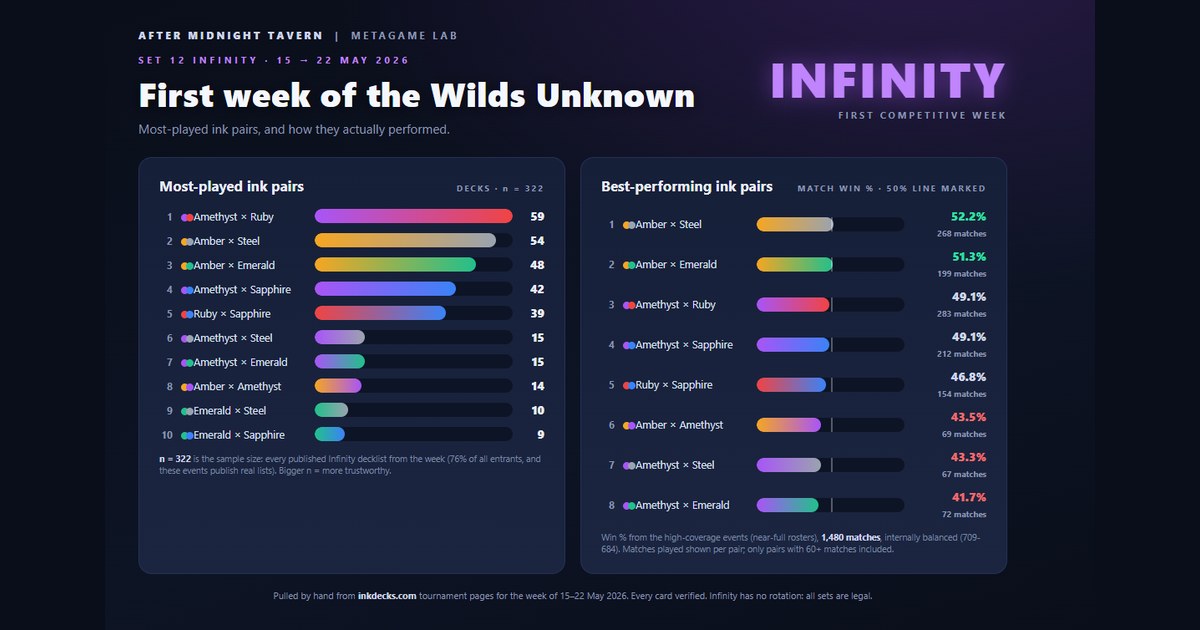
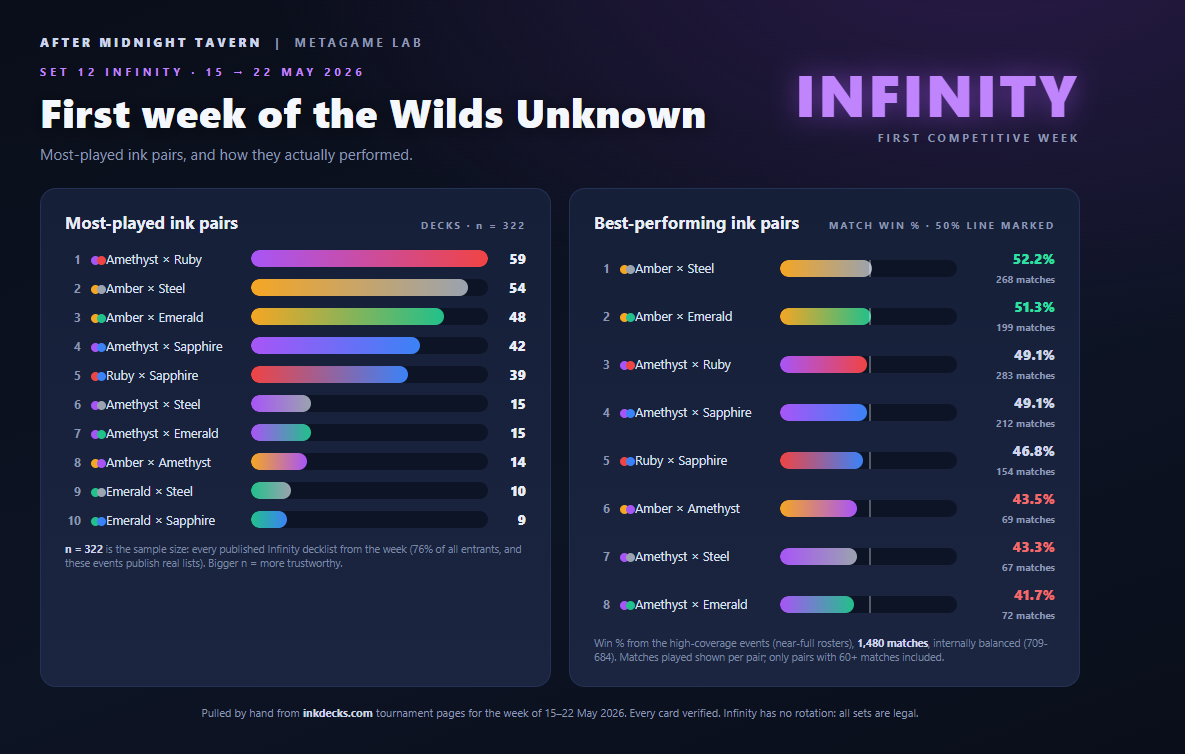
First, what people brought. Amethyst is the most-played ink in Infinity too, just like Core, so the demand center is consistent across both formats.
| Ink pair | Lists (of 322) |
|---|---|
| Amethyst/Ruby | 59 |
| Amber/Steel | 54 |
| Amber/Emerald | 48 |
| Amethyst/Sapphire | 42 |
| Ruby/Sapphire | 39 |
Single-ink share: Amethyst 45%, Amber 39%, Ruby 34%, Sapphire 30%, Emerald 26%, Steel 26%.
Now the part Core couldn’t support. Across the high-coverage events, more than 1,400 decisive matches, internally balanced (the field’s overall record is near 50/50, as it has to be), the win rates by ink pair come out like this:
| Ink pair | Match win rate | Matches | Record (W-L-D) |
|---|---|---|---|
| Amber/Steel | 52.2% | 268 | 140-110-18 |
| Amber/Emerald | 51.3% | 199 | 102-89-8 |
| Amethyst/Ruby (most-played) | 49.1% | 283 | 139-125-19 |
| Amethyst/Sapphire | 49.1% | 212 | 104-98-10 |
| Ruby/Sapphire | 46.8% | 154 | 72-62-20 |
| Amber/Amethyst | 43.5% | 69 | 30-37-2 |
| Amethyst/Steel | 43.3% | 67 | 29-37-1 |
| Amethyst/Emerald | 41.7% | 72 | 30-41-1 |
Same lesson as Core, now with the sample size to actually say it out loud: popularity is not performance. The most-played pair in the format (Amethyst/Ruby) lands dead mid-field at 49%. The pair quietly winning is Amber/Steel at 52% over 268 matches, with Amber/Emerald right behind it. The aggressive Amber decks are converting; the popular Amethyst decks are holding at par or below.
This is a real read, not a guess. Two-hundred-plus matches per top pair, list-backed, internally balanced. It is still one week, so it is a strong directional read rather than a settled tier list, but it is the kind of evidence Core week one never produced.
And here is the payoff for reading the actual lists instead of the color-pair bar. The single best-performing archetype in the format is hiding inside that Amber/Emerald bucket: the go-wide Lady — Decisive Dog and Tramp — Enterprising Dog lore-aggro deck. Isolated from the slower Amber/Emerald builds, the 36 Dogs lists went 93-58-12, a 57% match win rate over 163 matches, with multiple event wins (1st at 7-0-2, 1st at 5-1-0, two 2nd places). The plan is brutally simple: Lady — Decisive Dog turns every character you play into more lore, Tramp — Enterprising Dog gets cheaper and pumps as the board widens, and Tramp — Street-Smart Dog is the 7-cost top end that costs 1 less for each character you have, so it lands early on a full board and refills your hand. The Amber/Emerald ink-pair bar reads 51% because it averages this aggressive build together with slower decks. Pull the archetype out and it is the best thing in the format right now.
What’s defining the open format
Infinity has no rotation. Every set is legal, so nothing here is going anywhere this fall, and the format is defined by the deepest engines in the entire card pool rather than by what is newest.
That is exactly what the data shows. The ten most-played cards across all 322 lists are not Set 12 cards at all. They are established Infinity all-stars:
| Most-played card | Lists | Share |
|---|---|---|
| Friends on the Other Side | 119 | 37% |
| Elsa — The Fifth Spirit | 117 | 36% |
| Be Prepared | 101 | 31% |
| Rapunzel — Gifted with Healing | 97 | 30% |
| Madam Mim — Fox | 95 | 30% |
| Sail the Azurite Sea | 89 | 28% |
| Maui — Hero to All | 88 | 27% |
| Merlin — Goat | 87 | 27% |
| Pawpsicle | 86 | 27% |
| Tamatoa — Happy as a Clam | 81 | 25% |
Two things stand out. First, the big swing songs and value engines (Friends on the Other Side, Be Prepared, Rapunzel — Gifted with Healing) sit on top, which is what an open format with no rotation looks like: the strongest cards ever printed define it. Second, notice Elsa — The Fifth Spirit, Sail the Azurite Sea and Tipo — Growing Son. Those are the exact Amethyst and Sapphire carryover staples running the Core field too, and they are just as central here. The same shell anchors both formats; Infinity simply layers a deeper card pool on top of it.
So the question in Infinity isn’t “what rotates,” it’s “does anything in Set 12 push into a field this deep.” The answer is: yes, in a couple of specific places.
Where Set 12 is landing
These counts are from all 322 lists. Three Set 12 cards have pushed into the format in real numbers:
| Set 12 card | Lists (of 322) | Ink / cost | What it does |
|---|---|---|---|
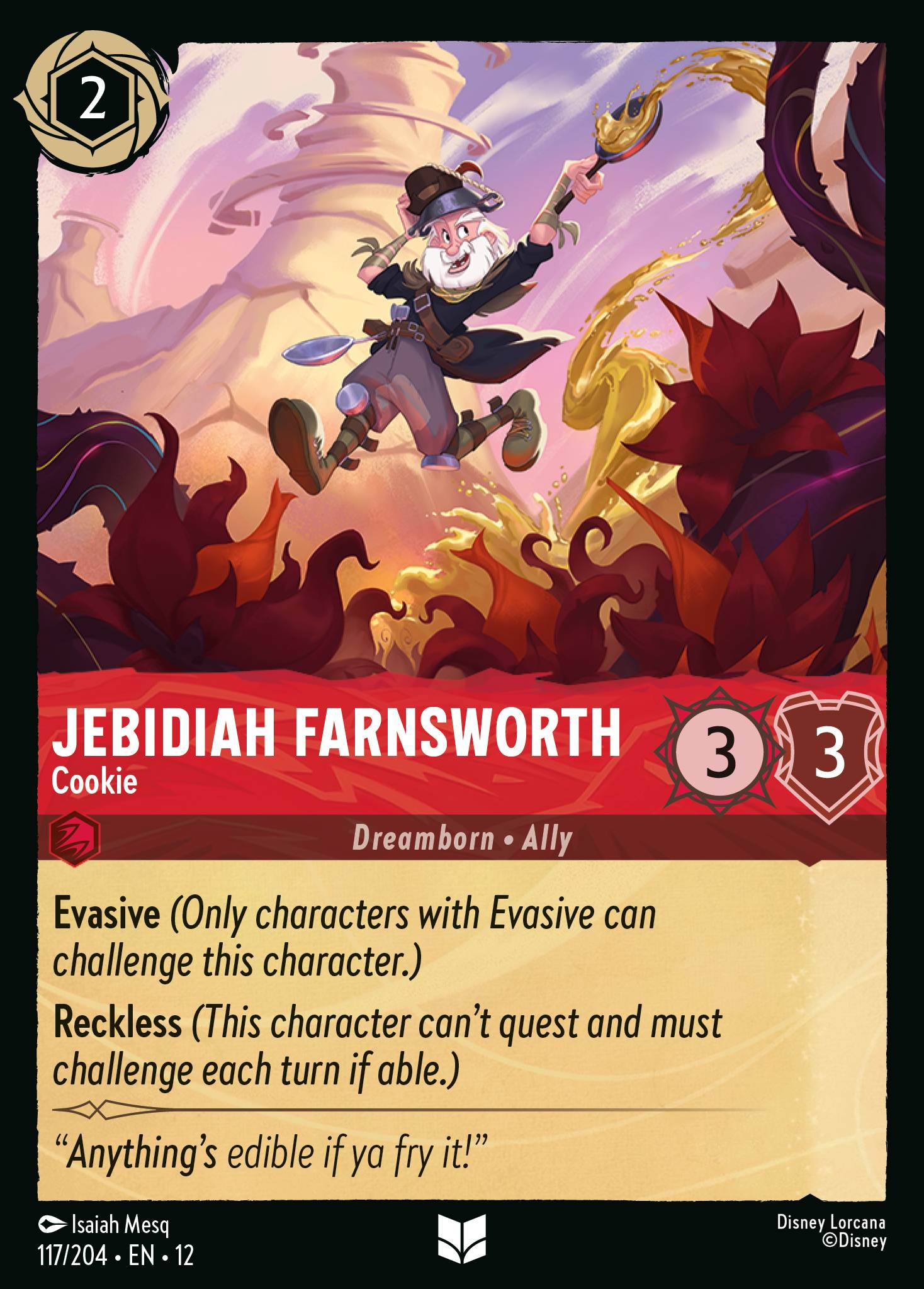
| Jebidiah Farnsworth — Cookie | 55 | Ruby 2c | Evasive + Reckless. A cheap evasive beater that drops straight into Ruby aggro. |
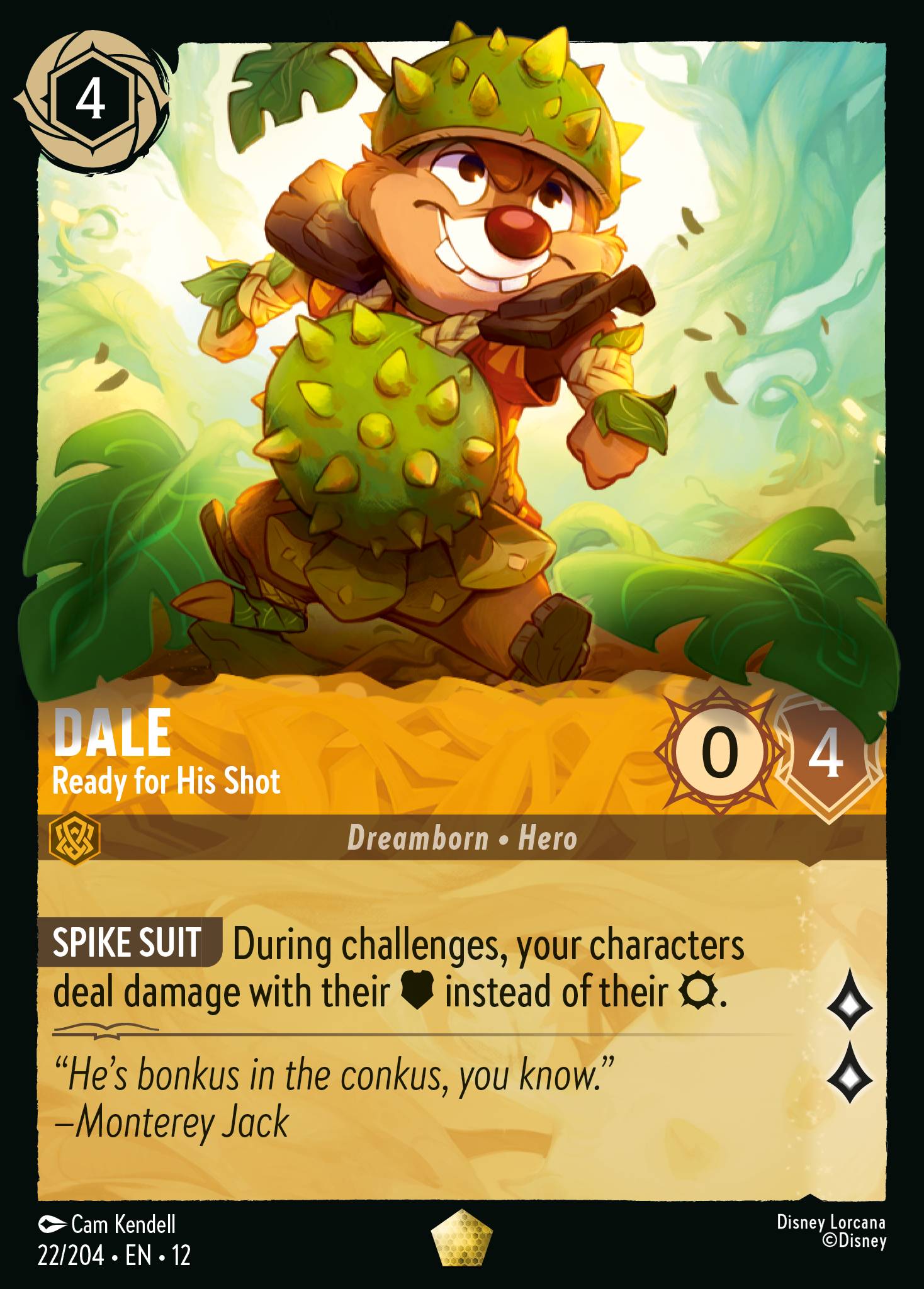
| Dale — Ready for His Shot | 46 | Amber 4c | Spike Suit: your characters deal damage with Willpower, not Strength. |
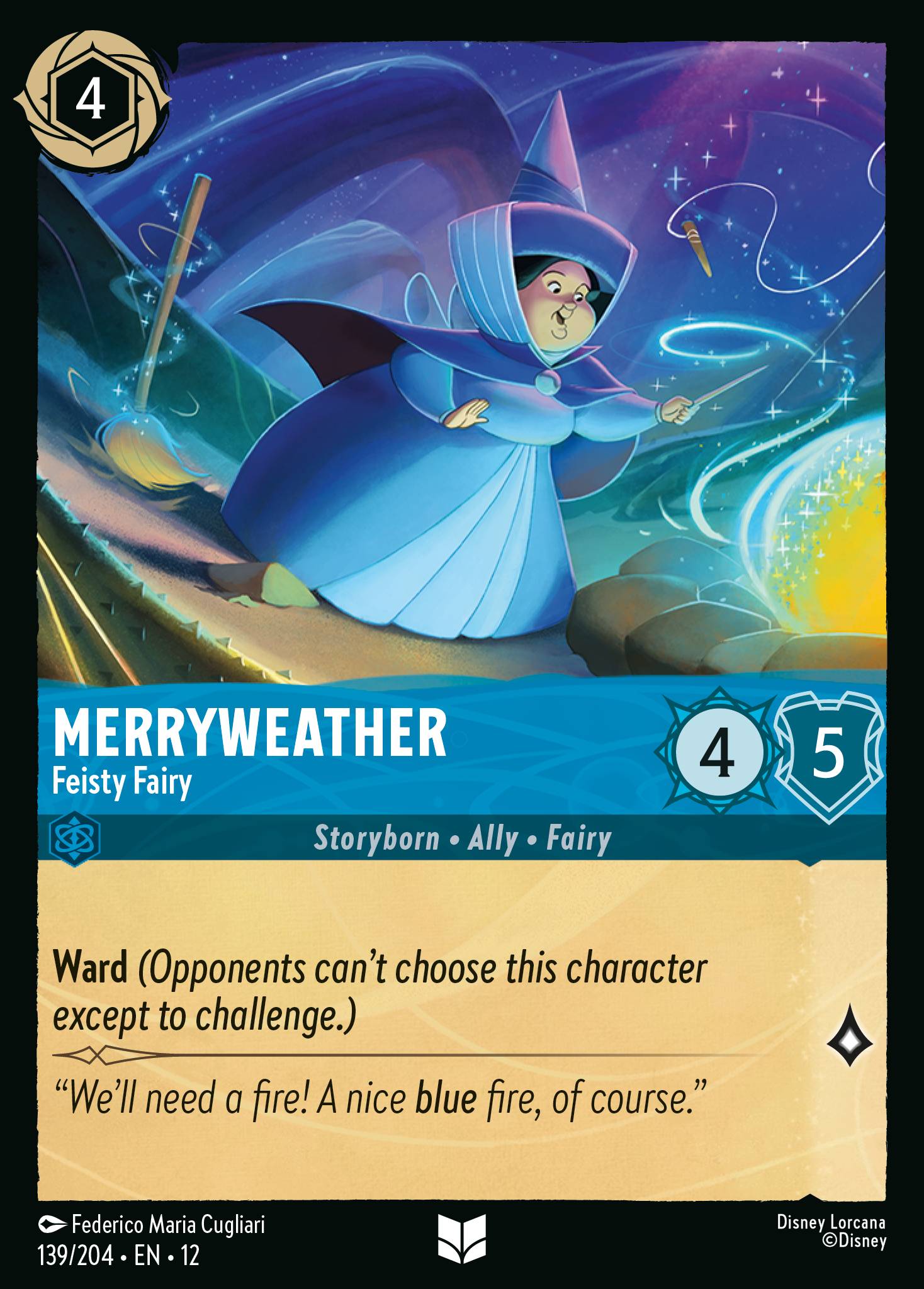
| Merryweather — Feisty Fairy | 43 | Sapphire 4c | Ward body, the same role it plays in Core. |
| Dash Parr — Lava Runner | 17 | Amethyst 4c | Rush, and can quest the turn it is played. |
| Will o’ the Wisp — Forest Spirit | 14 | Amethyst 1c | Returns to hand when banished in a challenge. |
| Diablo — Stone Servant | 14 | Steel 2c | Villain payoff: buffs and protects your Villains. |
| Rex — Protective Dinosaur | 11 | Amber 2c | Toy body for the Spike Suit shell. |
The card with the most Set 12 reps in Infinity is Jebidiah Farnsworth — Cookie, a 2-cost Evasive Reckless beater that needs no setup and slots straight into the Ruby aggro decks the format already runs. That is the open-format pattern again: the new card that catches on is the one that drops cleanly into a strong existing shell.
Now the cross-format through-line, with one important correction. Dale — Ready for His Shot is the most-played Set 12 card in Core, and the second-most in Infinity, so the Spike Suit payoff travels across both formats. But the two formats use it differently. In Core, a real share of the Dale decks are true toy-tribal builds anchored on Woody — Jungle Guide. In Infinity, Woody — Jungle Guide barely appears at all (2 lists in 322), so Dale here is not a toy engine. It is a Spike Suit combat-math payoff splashed into the two best-performing Amber pairs, Amber/Emerald and Amber/Steel (19 lists each). Infinity rewards the payoff, not the tribe.
Everything else from Set 12 is, so far, a role-player sliding into a shell that already existed.
Breakout combos look different in Infinity
In Core, the new package was self-contained: Set 12 toy cards comboing with other Set 12 toy cards. Infinity has no rotation and the whole card pool to draw from, so its breakout combos are not new-with-new. They are one new Set 12 card plugged into a deep, established engine. Looking at which cards show up together across all 322 lists, four stand out:
- Dale — Ready for His Shot + Rapunzel — Gifted with Healing (45 of 46 Dale decks, 52% win rate). This is the real combo, and it is pure Infinity. Rapunzel is a 1/5: one Strength, five Willpower. Normally she challenges for 1. With Dale’s Spike Suit turning damage into Willpower, that same Rapunzel hits for 5, while staying a 5-Willpower wall that heals and draws. A four-year-old card becomes a finisher because of one new printing.
- The Leviathan — Guardian of Atlantis + the Ruby/Sapphire ramp-and-mill engine (all 11 of its decks are Ruby/Sapphire and run Develop Your Brain, Sail the Azurite Sea, Maui — Half-Shark). Leviathan is a Ruby 10-cost 10/10; Sapphire supplies the ramp and card flow, Ruby supplies the discard fuel and the body. The Set 12 card is just the banish-everything finisher bolted onto an old self-mill ramp deck.
- Merryweather — Feisty Fairy + Amethyst/Sapphire control (42 of 43 run Tipo — Growing Son and Sail the Azurite Sea, 40 run Hades — Infernal Schemer). A new Ward body inside the format’s oldest control core.
- Jebidiah Farnsworth — Cookie + the Ruby control shell (54 of 55 run Be Prepared, alongside Madam Mim — Fox and Friends on the Other Side). Not a synergy combo, just the cheap evasive clock the deck was missing, played before the Be Prepared board wipe resets everything.
The throughline: in an open format, a new card breaks out by making an old card better, not by building a new tribe from scratch.
What this data can and cannot tell you
It can tell you: what the open format actually looks like with deep coverage, which ink pairs are over- and under-performing across hundreds of matches, what the format’s defining engines are, and where Set 12 is breaking in.
It cannot tell you: per-matchup percentages to full confidence, or a settled multi-week tier list. It is still one week. But unlike Core, the ink-pair performance read here rests on a real sample, so it is a strong directional read rather than a coin flip.
The honest week-one Infinity read: Amethyst is the demand center but Amber is the performer, the best-performing archetype is the go-wide Lady — Decisive Dog / Tramp — Enterprising Dog lore-aggro deck at 57%, the format is still defined by its deepest older engines, and the clearest Set 12 footprint is Jebidiah Farnsworth — Cookie in Ruby aggro plus Dale — Ready for His Shot as a Spike Suit payoff that turns old high-Willpower cards into finishers.
How we did this
We went through the Infinity events from the window (May 15 to 22) and read every published deck, pulling the win/loss records straight off the event pages, the same pages any player can open. Every card name in all 322 lists was checked by hand against the official Lorcana card data, so set membership, ink, type and ability text are read, never recalled. Coverage, win rates, and the card-level counts all use the full field.