
How to Build a Format Coconut Deck
A step-by-step guide to building your first 60-card Format Coconut deck: picking a Coconut, choosing your third ink, and the singleton math that decides whether your deck actually does what you built it to do.

Format Coconut asks you to do something no other Lorcana format does: fill sixty slots with sixty different cards and still have the deck work every game. If you have only ever built regular constructed decks, your instincts are about to lie to you. Four copies of the good card is not on the menu. Neither is the tight two-ink curve you have been drilling.
This guide is the build process we use, in order, with the numbers behind each step. If you have not read how the format works yet, start there and come back. This one assumes you know the rules and want to know what to actually put in the deck.
Format Coconut is in open beta, so this is a living guide. We will keep it current as Ravensburger tunes the format.
Step 1: Pick your Coconut, and check what it really costs
Everything downstream is decided here. Your Coconut fixes one of your three inks, sets your theme, and names the one card you are allowed to run four copies of. Most players call this your leader, and we use the two words interchangeably.
Choosing it is free in the companion app. What is not free is the playset. The one exception to the singleton rule is the card your Coconut names, and you want all four copies, because it is the only consistency the format sells you. So the real question when picking a Coconut is: how much does that one playset cost?
The answer varies enormously, and it is the single biggest budget decision you will make. Some anchors are bulk commons you can complete for pocket change. A couple of them are chase cards where four copies cost more than most people’s entire deck.
Here are all eighteen, with the ink each one locks in and what it wants you to build.
| Coconut | Ink | Builds around |
|---|---|---|
| Ariel - Spectacular Singer | Amber | Princesses singing songs for lore |
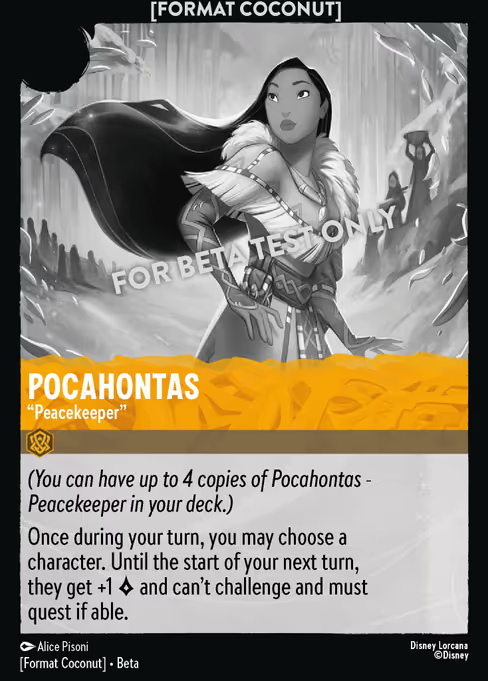
| Pocahontas - Peacekeeper | Amber | Buffing lore and locking down a blocker |
| Stitch - Rock Star | Amber | Free cheap characters, every turn |
| Dumbo - Ninth Wonder of the Universe | Amethyst | Exert abilities that fire immediately |
| Snow White - Merry as the Morning | Amethyst | Seven Dwarfs, spread across names |
| Winnie the Pooh - Hunny Wizard | Amethyst | Plain vanilla characters as card draw |
| Donald Duck - Fred Honeywell | Emerald | Boost abilities at a discount |
| Robin Hood - Sneaky Sleuth | Emerald | Damaging the whole table, then punishing it |
| Ursula - Deceiver of All | Emerald | Songs, sung by bodies punching above their weight |
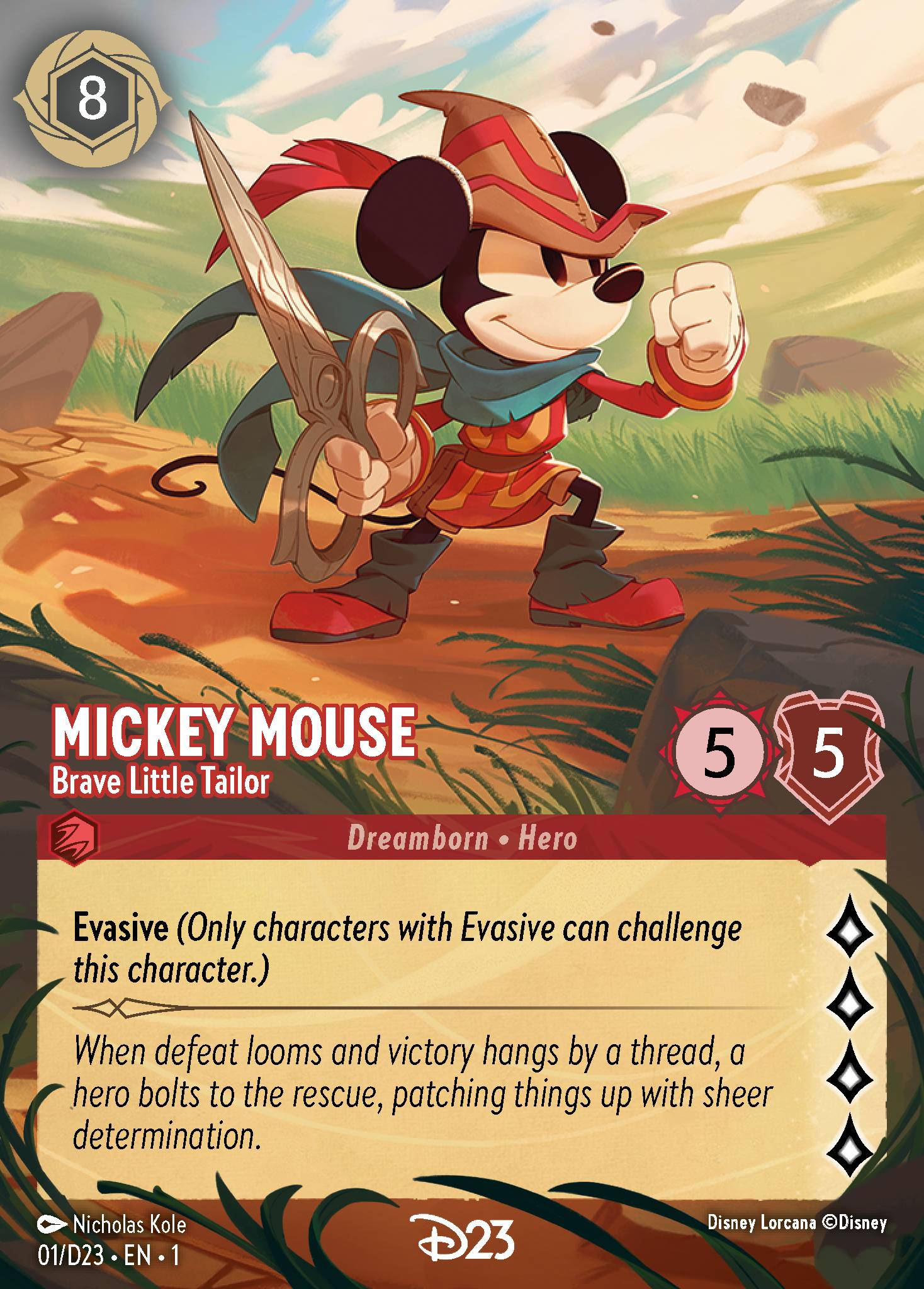
| Mickey Mouse - Brave Little Tailor | Ruby | Every Mickey in the deck, chained through Shift |
| Mr. Incredible - Super Strong | Ruby | Super characters arriving with Rush |
| Sisu - Emboldened Warrior | Ruby | Big bodies questing the turn they land |
| Moana - Curious Explorer | Sapphire | Ramp, and inking from your discard |
| Mufasa - Ruler of Pride Rock | Sapphire | A big one-shot ink burst |
| Nick Wilde - Wily Fox | Sapphire | Items, cashed in four at a time for lore |
| John Silver - Greedy Treasure Seeker | Steel | Locations as a defensive engine |
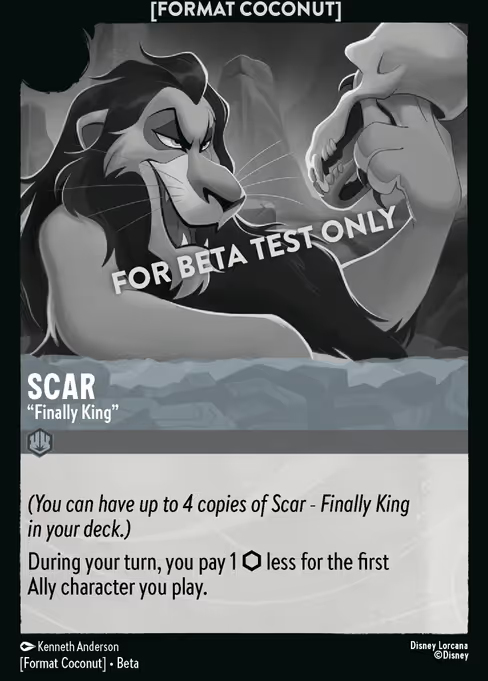
| Scar - Finally King | Steel | Ally tribal, cheaper and bigger |
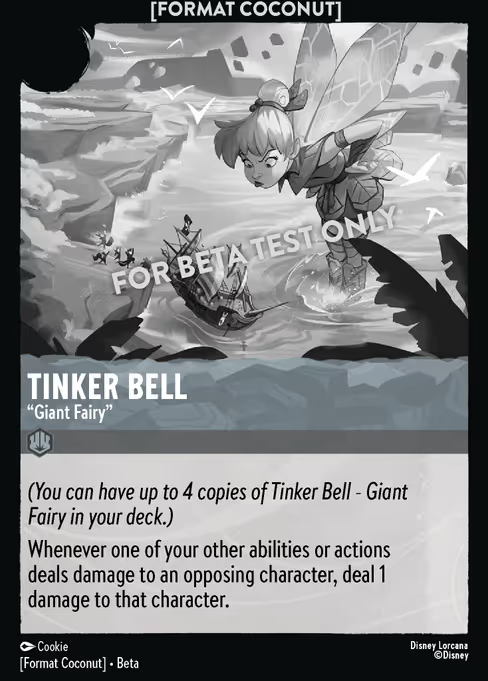
| Tinker Bell - Giant Fairy | Steel | Doubling the damage of every sweeper you cast |
A note on that last one, because it is the most underrated line on the table. Tinker Bell adds a point of damage every time one of your other abilities or actions damages an opposing character. In a format where “deal 1 damage to each opposing character” is one of the most-played effects, that turns every sweeper you own into a 2-damage sweeper across three opponents. It does not trigger off challenge damage, only abilities and actions.
And one for the contrarians: as of our August 25 pull, Scar - Finally King had just two community decks out of 91, the fewest of any Coconut that anyone has built at all. Pocahontas - Peacekeeper had none. If you like being first somewhere, those are the open lanes.
Practical advice: pick the Coconut whose named card you can complete four copies of without wincing, and whose cast you actually like. Theme and budget are both legitimate reasons here. Power level is the least important of the three, because the format is casual by design and games run long enough that most plans get to happen.
Step 2: Choose your other two inks by what is missing
Your Coconut locks one ink. You get two more, and almost everybody wastes them.
The instinct is to pick inks that support the theme. Resist it. Lorcana ink is colorless when you spend it, so a third ink costs you nothing in consistency, and that means the third ink is a quality lever, not a theme lever. Spend it on the hole in your deck.
Before you write a single card down, look at what your first two inks give you access to and count the things you have none of:
- Card draw. Non-negotiable, and we will get to how much.
- Effects that hit every opponent. Sweepers and “each opponent” cards.
- Removal that answers a single scary thing.
- Healing or Resist, if your plan is to survive to a long game.
- Ramp, if your curve tops out high.
Then pick the third ink that fills the most empty buckets. When we built our Winnie the Pooh deck, the first draft ran Amethyst, Ruby and Steel and had zero Ward effects available and almost no healing. Swapping Ruby for Sapphire, same Coconut and same theme, opened up ramp, Ward, Bodyguard, healing and one-sided sweepers. Identical concept, structurally a different deck.
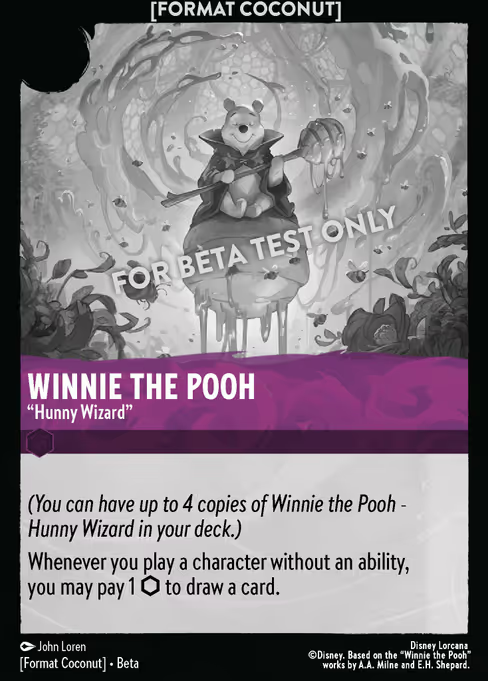
Count the absences first. Write the list second.
For what it is worth, 86 of the 88 valid community decks in our August 25 pull ran the full three inks. Of the two exceptions, one is a two-ink deck and the other is a Winnie the Pooh deck using a card that explicitly overrides the ink limit. There is no hidden advantage to staying narrow.
Step 3: Lay in the playset and the theme, in that order
Now you build, and the order matters because the early slots are the constrained ones.
Four copies of your Coconut’s card. Always all four. It is the only card in your deck you can count on drawing.
This is the step that confuses people, because the two things share a name. They are not the same object. Here is the Coconut:
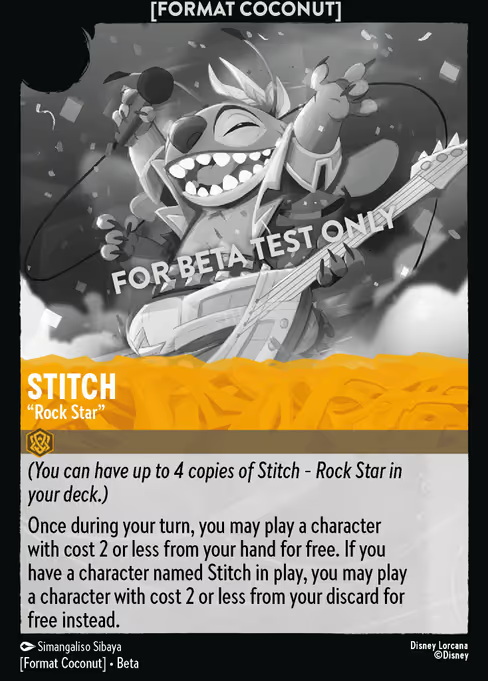
That one lives in the app. It never enters your deck, it costs nothing, it takes up no slot, and nobody can remove it. Its ability is simply on, all game.
And here is the card it unlocks, which is an ordinary Lorcana card you need four physical copies of:
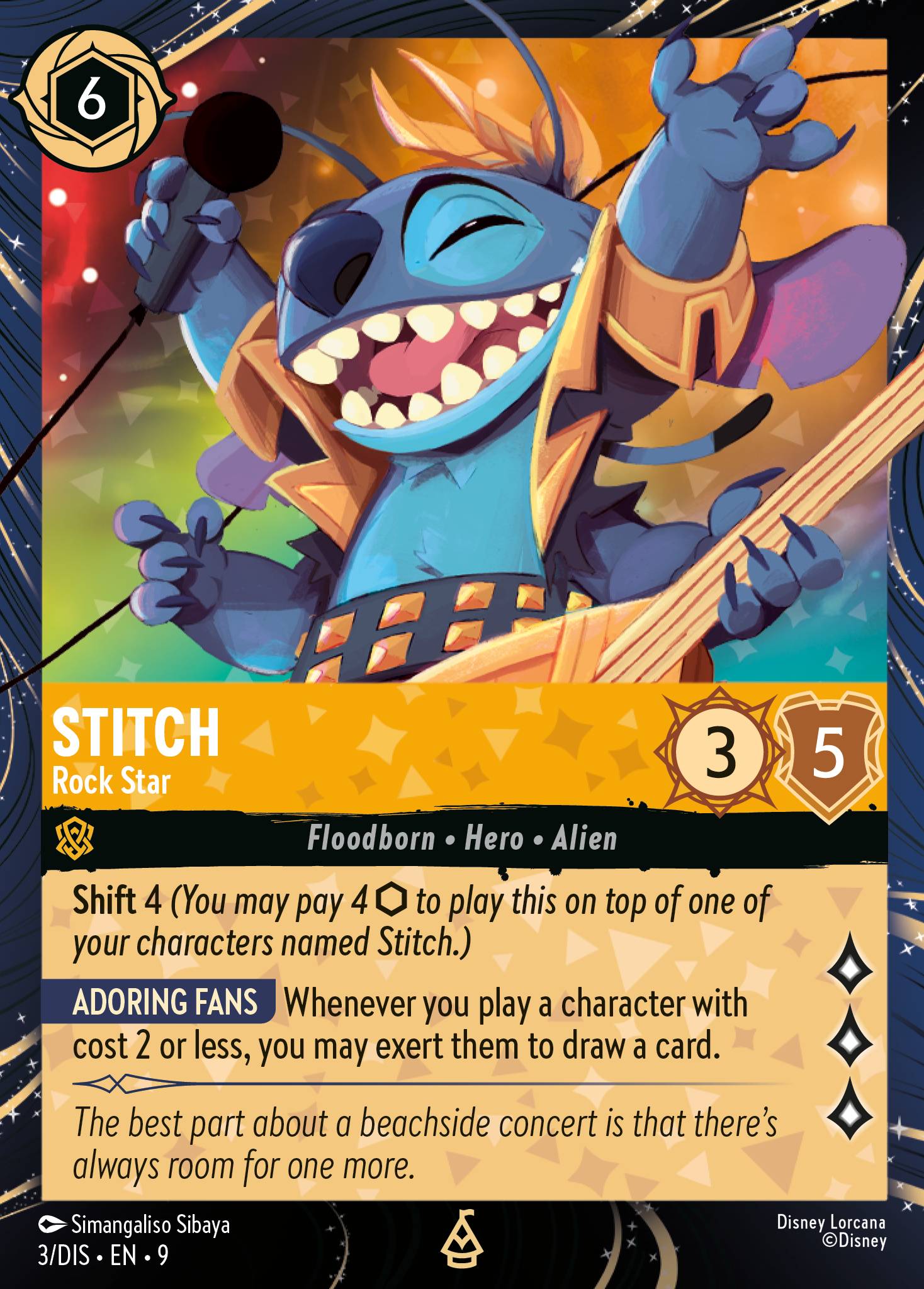
Same name, different jobs. When a guide says “the Stitch Coconut” it means the first one. When it says “the playset” it means four of the second.
The Coconut does not count as one of your four. This trips people up, so to be completely clear: the Coconut sits outside your deck, so it is not a copy of anything. The reminder line printed on it says “you can have up to 4 copies of Stitch - Rock Star in your deck,” and your deck is the thing the Coconut is not in. You still build with a full four physical copies, and you still need to own four. Picking the Coconut does not get you one of them for free.
It works the other way round too. Owning the real card, or having it in play, does nothing to your Coconut. The Coconut’s ability is on from turn one whether or not you have ever drawn the card that shares its name.
Then the theme cards that survive a rate check. Here is the test: pretend the theme does not exist and ask whether you would run that card anyway for its cost and stats. If yes, keep it. If it is only good when three other specific cards are on the table with it, it is a trap, and the next step explains exactly why.
Then your engine. The eight to fifteen cards that generate lore or cards every game and directly feed what your Coconut does. If your Coconut rewards cheap characters, that is your cheap characters. If it rewards items, that is your items.
Step 4: Count roles, not copies
This is the single most important idea in singleton deckbuilding, and it is where most first decks fall apart.
Playset discipline in normal constructed exists to guarantee redundancy, meaning the deck can reliably find a card that does the job. Singleton bans copy redundancy. It does not ban redundancy. It just moves it.
Your deck is a “four-of” in a role when four different cards fill that role.
The math is stark. In a 60-card deck:
| What you are looking for | In your opening hand | By turn 7 |
|---|---|---|
| One specific card | about 12% | about 22 to 28% |
| Any of four cards that do the same job | about 40% | about 64% |
A plan that needs one named card works about one game in four. A plan that needs any of four interchangeable cards works two games in three. Same singleton rule, completely different deck.
The corollary matters even more: two-card combos are dead. Two specific singletons both showing up by turn 7 is about 9%. By turn 4 it is 3.1%. If a deck guide tells you “turn 4, play X into Y and win,” that line happens in one game in thirty. Do not build around it. Enjoy it when it happens.
The one card that ignores all of this
There is exactly one legal way to buy your consistency back, and most people do not know it exists.
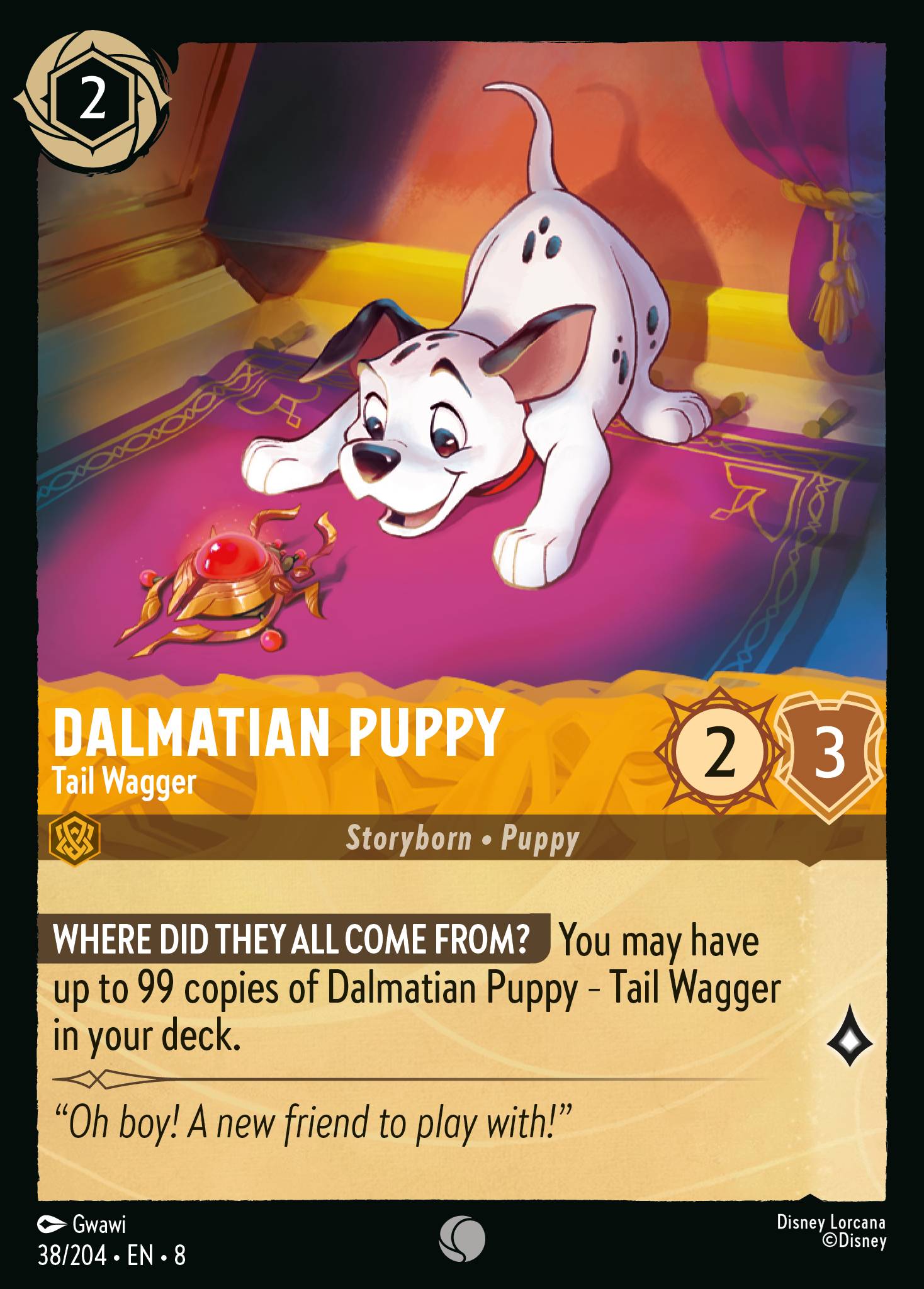
Dalmatian Puppy - Tail Wagger is a 2-cost Amber character that reads, in full: “WHERE DID THEY ALL COME FROM? You may have up to 99 copies of Dalmatian Puppy - Tail Wagger in your deck.”
Card text that changes deck construction beats the format’s copy limit, the same way it beats the ink limit elsewhere. So if your Coconut lets you play Amber, you have access to a legal ninety-nine-of in a format whose entire defining constraint is that you cannot run two of anything.
This is not theoretical. Two decks in the current community pool already do it, one with 32 copies and one with 20, and both are flagged legal. A deck that is one third a single known two-drop plays nothing like a normal singleton deck, because every probability in the table above stops applying to a third of your cards.
Whether that is good is a separate question we are not going to pretend to have settled. But you should know the door is there.
So when you audit your list, stop asking “how many copies?” and start asking “how many different cards do this job?” Aim for roughly four distinct cards in each role you actually need.
Step 5: The tribal trap, and why names are different from types
This one cuts directly against instinct, so read it twice.
The one-copy rule counts the full name, meaning name and subtitle together. That produces two opposite consequences that look similar and behave nothing alike.
Names survive singleton. Elsa - Snow Queen and Elsa - Spirit of Winter and Elsa - Ice Surfer are three different cards. Run all three. Every card that cares about a character being named Elsa sees all of them. Shift still works, because any Elsa can Shift onto any other Elsa. “While you have a character named X in play” still works. Your binder full of assorted versions of one character is not spare parts, it is a deck.
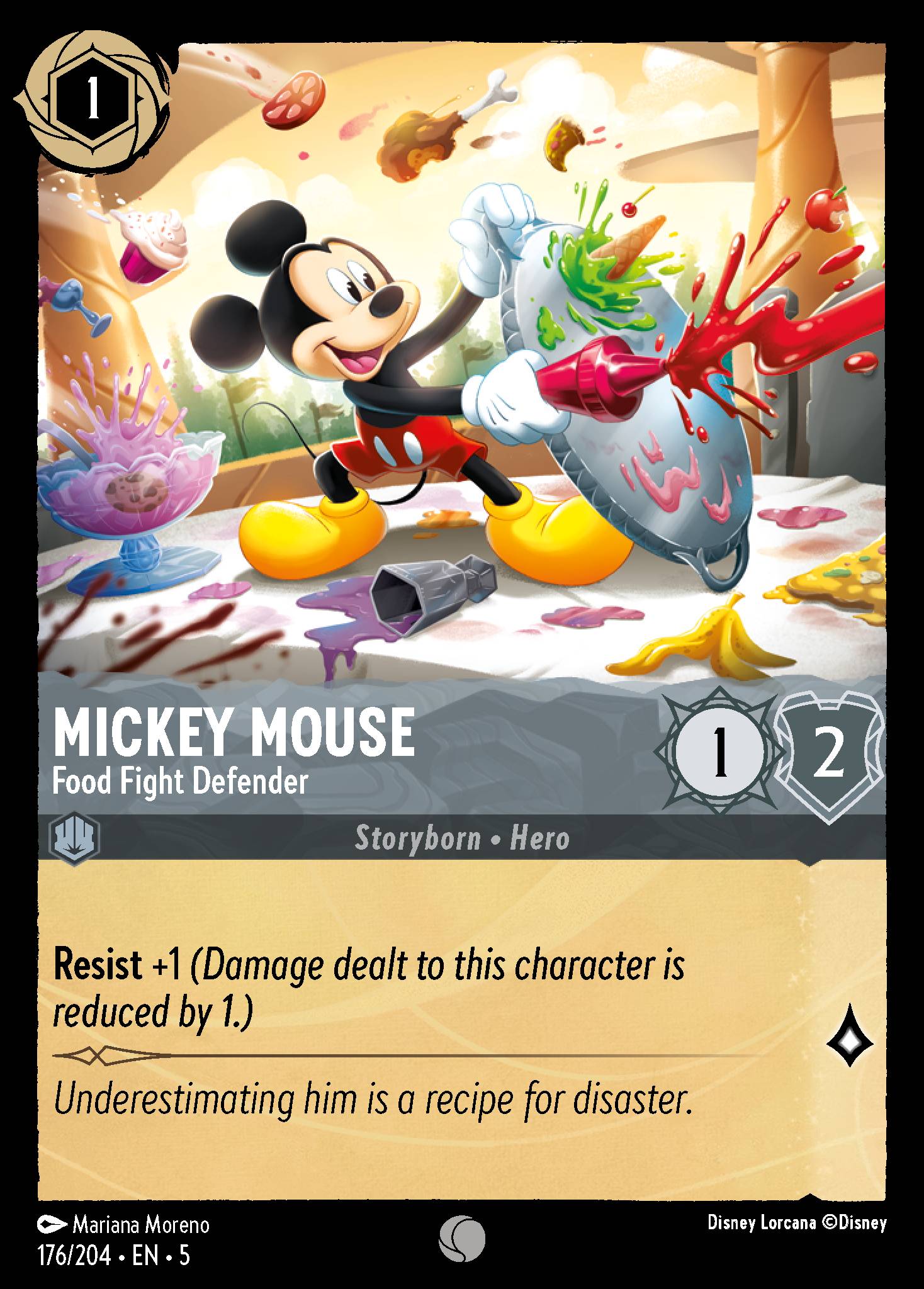
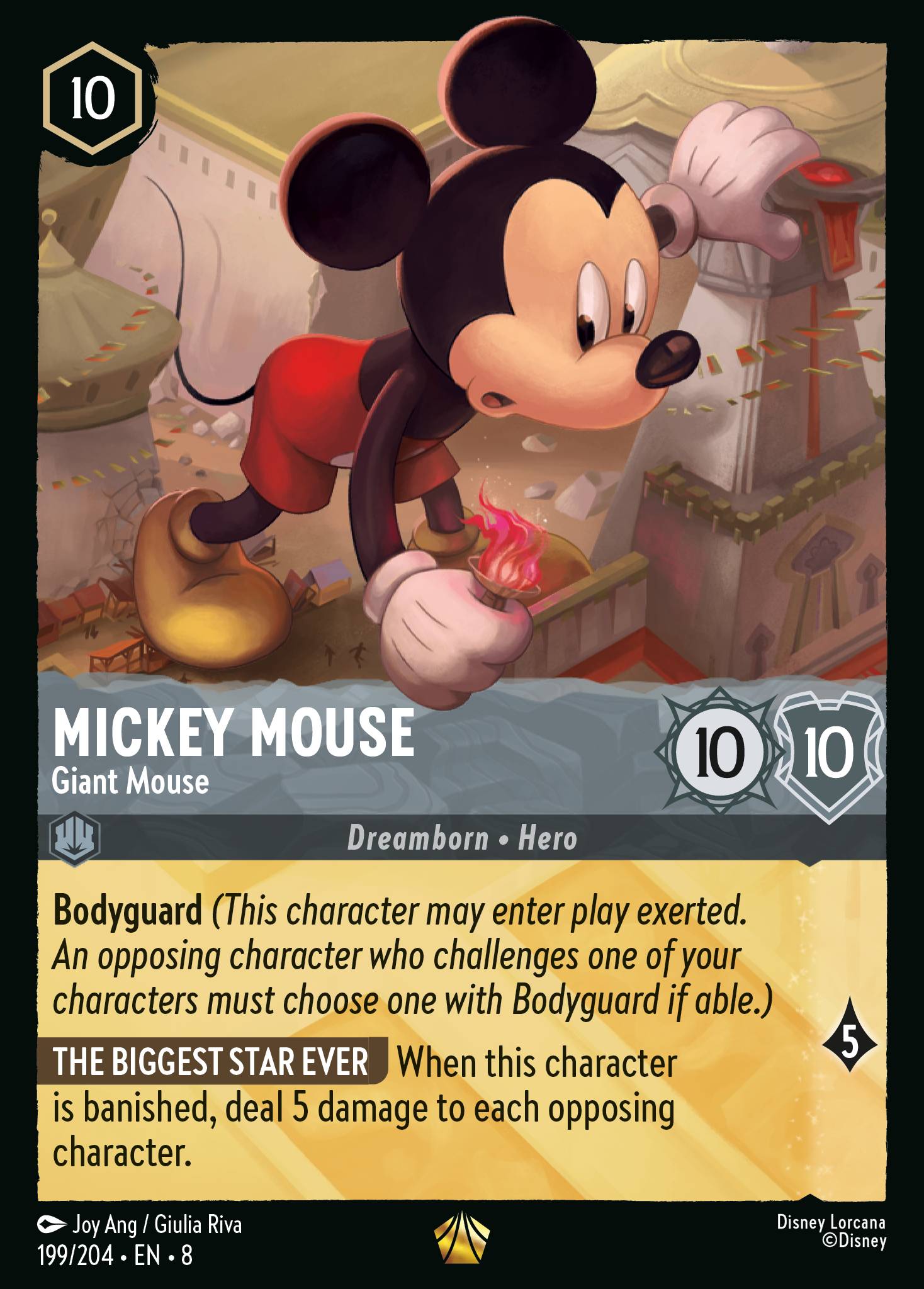
Classifications do not survive singleton. A card that reads “while you have 2 or more other Hunny characters in play” needs several different cards on the board at the same time, each of which is a one-of, each of which had to be drawn, played, and survive a table of three opponents.
We simulated this on the largest subtype pool available in the format, across tens of thousands of games:
| Turn 4 | Turn 6 | Turn 8 | |
|---|---|---|---|
| Two or more of the tribe in play | 10 to 17% | 38 to 39% | 42 to 70% |
| Same, allowing for a four-player board getting cleared | 5.7% | 25.4% | 58.2% |
| Three or more in play | 1 to 3% | 11 to 21% | 22 to 36% |
And the fix everyone reaches for makes it worse. We rebuilt the deck at the legal maximum number of tribal cards. Three or more in play at turn 6 rose to only about 21%, while the deck’s actual engine shrank by 24%, because every tribal card added displaced a card that was doing real work.
The rule: in a singleton format, treat “while you have two or more other [type]” as blank text. Treat “one other [type]” as a coin flip. The card has to be worth its slot on cost and stats alone. If it is, keep it and enjoy the bonus when it shows up.
So where does the theme go? Into the cast. In our Pooh deck the Hunny subtype was 16 cards, five of them in inks we were not playing. The Winnie the Pooh story pool was 34 legal cards in the same three inks. We ran 20 of them. The deck reads as a Hundred Acre Wood deck from across the table, every card earns its slot on rate, and not one line depends on a keyword assembling.
Build the theme out of who is on the table, not out of a mechanic.
Step 6: Draw and sweepers, because the pod changes card values
Four-player Lorcana is not two-player Lorcana with more chairs. Several constructed instincts invert:
- Effects that hit every opponent get two to three times better. One card hits three boards. These are the premium cards of the format.
- One-for-one removal gets roughly a third as good. You answer one card from one opponent while the other two advance for free. Save it for what genuinely scares you.
- Card draw compounds. The race to 25 lore runs about 25% longer than a normal game, and there are more turns between yours. Engines have time to take over in a way they never do in a two-player race.
- Bodyguard and “must challenge me” effects are close to blank. Three opponents racing on lore are not obliged to attack you at all.
- High willpower is not protection. Effects that banish damaged characters, or banish everything, ignore stat lines. On a four-player board roughly a third of characters are already chipped at any given moment, so “nothing of mine dies to a small sweep” is usually wrong.
- Locations survive board wipes. That is real, cheap insurance.
The community lists agree about draw. They disagree with the theory about sweepers, and that turns out to be the more interesting result. Here are the most-included cards across 88 legal community decks, with what each one actually does:
| Share of decks | Card | What it actually does |
|---|---|---|
| 49% | Friends on the Other Side | Draw 2 cards |
| 38% | Colors of the Wind | Each player reveals their top card; draw one per different ink revealed |
| 34% | Sail the Azurite Sea | Ink an extra card this turn, and draw one |
| 33% | Strength of a Raging Fire | Damage to one character equal to your character count |
| 33% | Be King Undisputed | Each opponent banishes a character of their choice |
| 32% | Junior Woodchuck Guidebook | Tap and banish it to draw 2 |
| 30% | Be Prepared | Banishes all characters, yours included |
| 27% | Chernabog’s Followers - Creatures of Evil | Banish it on quest to draw a card |
| 26% | A Pirate’s Life | Each opponent loses 2 lore, you gain 2 |
| 25% | Grab Your Sword | 2 damage to each opposing character |
Notice what is not there. Exactly one card in that list is a true sweep across the whole pod, and it sits at the bottom. We measured every deck in the corpus, and the median number of cards that damage every opposing character is zero. Only 42 of 88 decks run even one.
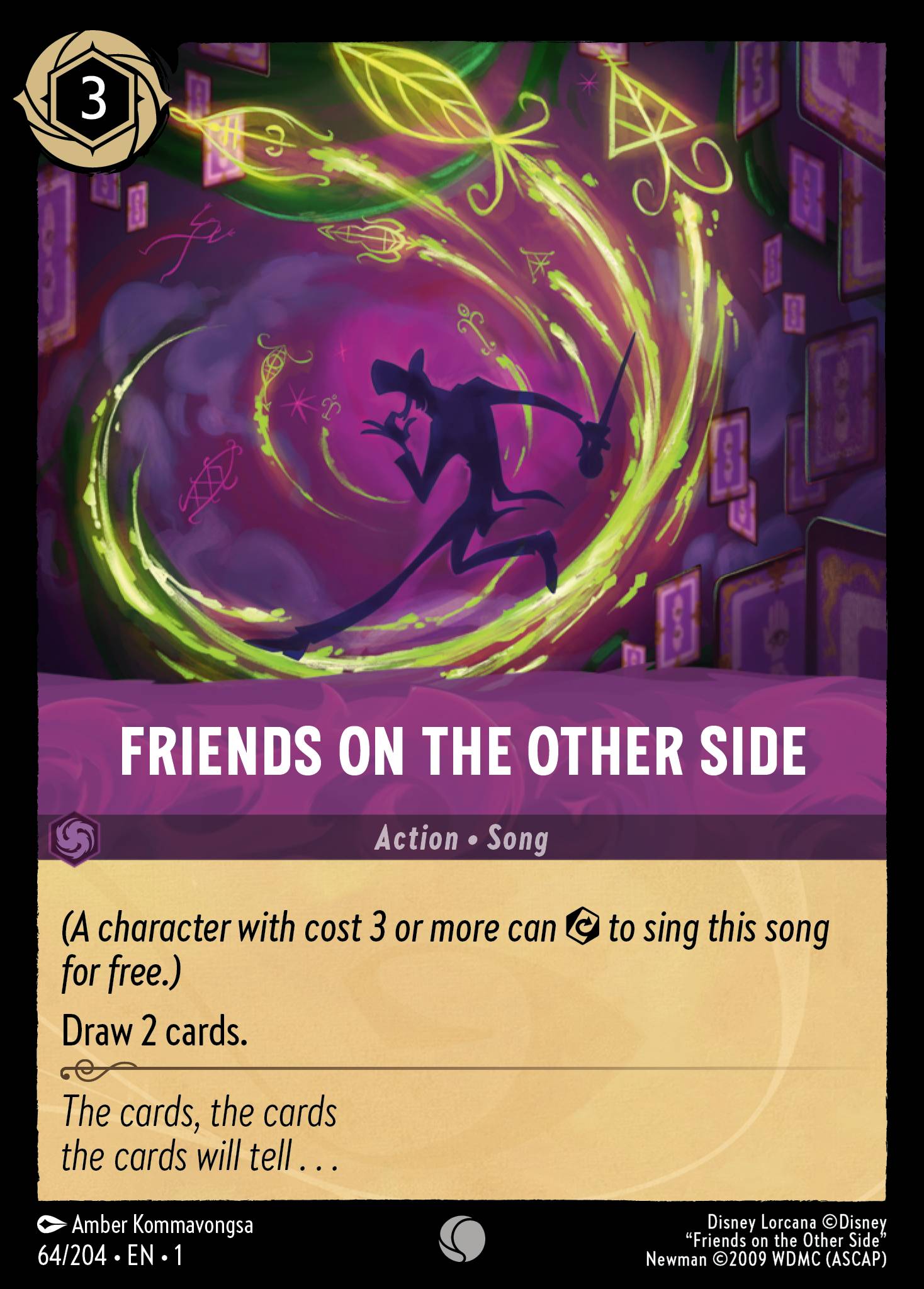
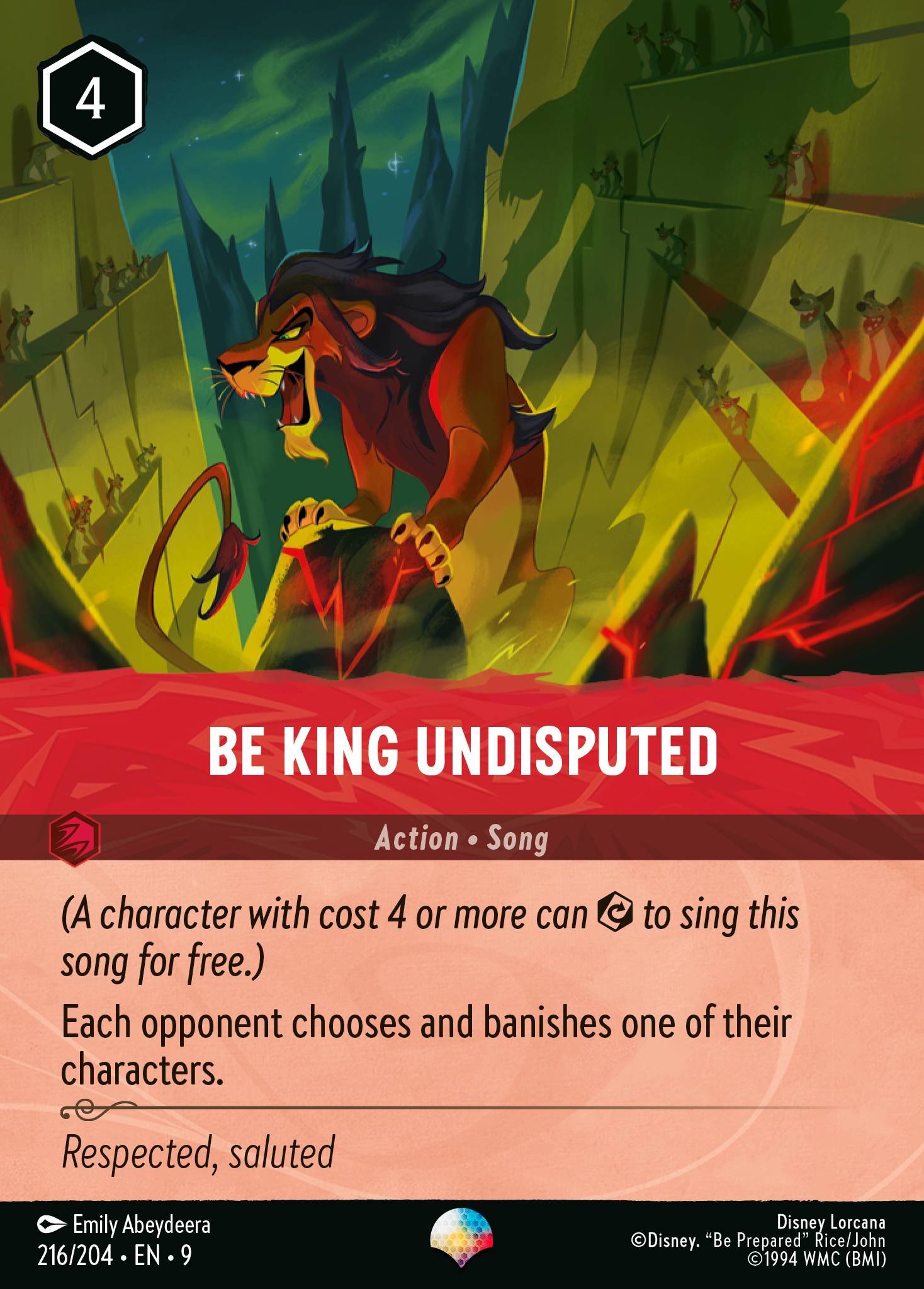
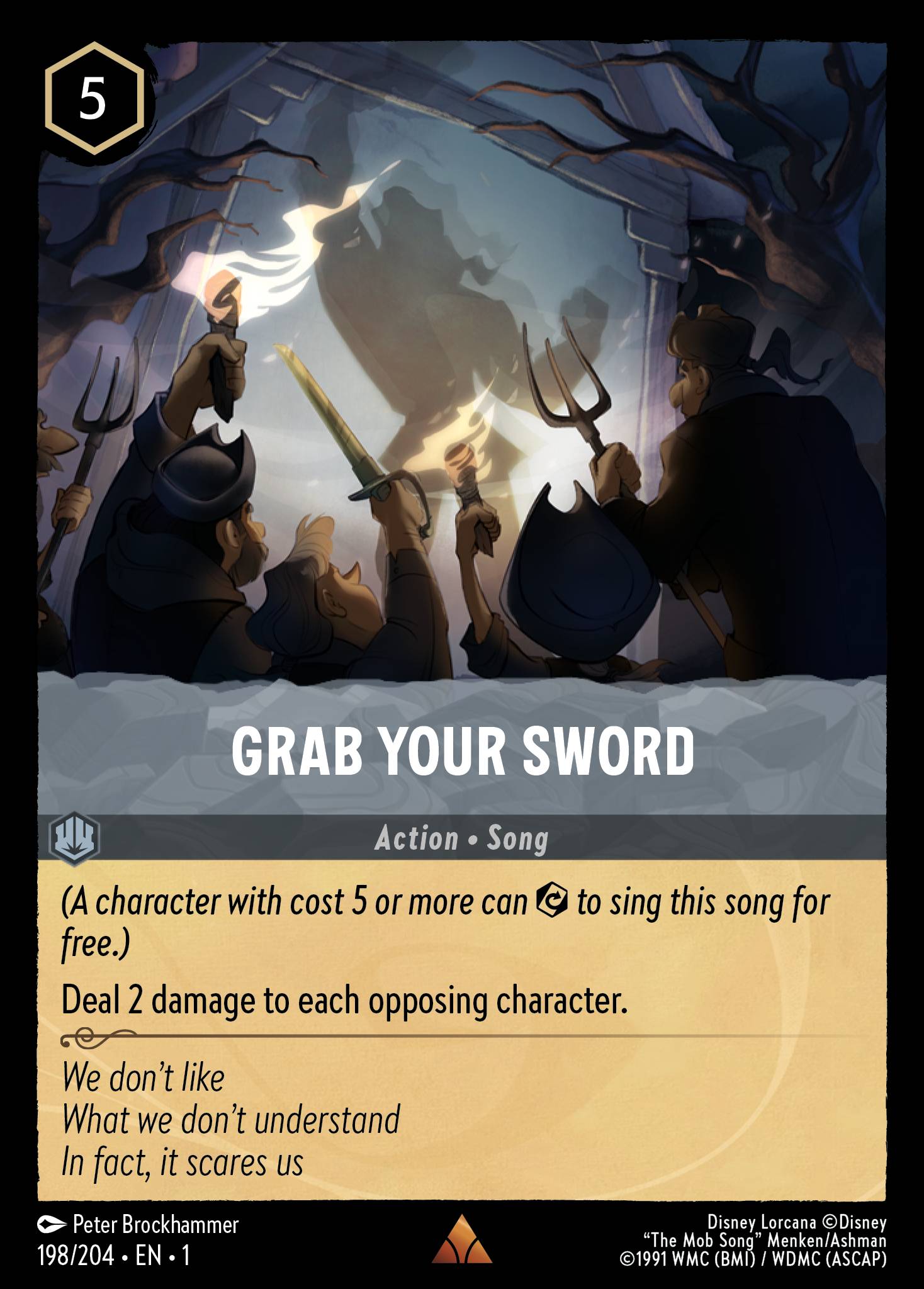
That is worth sitting with, because the theory says pod sweeps should be the format’s premium effect. Two things are going on. First, there simply are not many: a three-ink pool holds only around a dozen of them, and most are unplayable. Second, the community reaches for different tools to attack the whole table. Be King Undisputed makes every opponent sacrifice something. Be Prepared wipes the board including your own. A Pirate’s Life drains lore from all three opponents at once, which in a race to 25 is a sweeper of a different kind.
So target roughly eight different draw effects, and treat “hits the whole table” as one role filled by any of those four tools, not specifically by damage. Not eight copies. Eight different cards. That is Step 4 applied to the roles that matter most.
Two corrections we owe you, since an earlier version of this guide got them wrong: And Then Along Came Zeus and Let the Storm Rage On are commonly described as sweepers and are not. Zeus deals 5 damage to one chosen character or location; Storm deals 2 to one chosen character and draws you a card. Both are fine cards. Neither hits the table.
One honest caveat, because we would rather tell you than have you find out at the table: six pieces of interaction spread across 60 cards cannot police three opponents. In simulation, roughly a third of games cast zero interaction at all. A singleton deck is a race deck with answers, not a control deck. Build it as a race and you will be happy.
Step 7: Keep your inkable count high
This is the most distinctive number in the whole format, and it is the one most new builders get wrong.
Community Coconut decks run a median of about 77% inkable cards, roughly 46 of 60. Regular constructed decks sit closer to 60%.
The reason is structural. Singleton means you cannot guarantee your curve, and 25 lore means the game is long. Both of those problems are solved by never missing an ink drop. When you are choosing between the flashy uninkable card and the solid inkable one, take the inkable one more often than feels right.
For reference, the average community deck has an average card cost of about 3.66, and the curve looks roughly like this per 60 cards: seven one-drops, twelve two-drops, twelve three-drops, eleven four-drops, seven five-drops, and about ten cards above that. Card types run about 68% characters, 22% actions, 8% items, 2% locations.
Use that as a sanity check, not a straitjacket.
Step 8: Fill to 60, then run the checklist
Round out with cheap, flexible, inkable cards. Utility characters, questers, and answers. Then check the list against this before you sleeve it:
- Exactly 60 cards, or a couple more if you must. Sixty is the norm and shorter is better.
- Four copies of your Coconut’s card, one copy of everything else.
- Three inks or fewer, one of them matching your Coconut.
- About 46 of 60 inkable.
- Eight or so different draw effects.
- Five or six different mass-damage effects.
- Every single card in the deck would be fine to draw on turn three. There is no “I only put it in for the combo” slot.
- No plan anywhere that requires two specific cards.
What to cut when you are three cards over
Everyone lands at 63. In order, cut:
- The second card that does the same narrow thing your engine already does. Depth in one role beyond four distinct cards is waste.
- Anything gated on a classification count. See Step 5.
- Uninkable cards that are not doing something you cannot get elsewhere.
- Your most expensive card, if you are above ten cards costing six or more.
- Single-target removal, down to about three or four pieces. It is the worst removal in a pod.
Cut the theme card last, but do cut it if it is genuinely doing nothing. A theme you lose with is not a theme.
The four mistakes we see most
Building the tribe instead of the deck. Covered above at length, because it is the expensive one.
Treating the Coconut as a bonus instead of the engine. When we first modelled our Pooh deck we assumed its Coconut would trigger about twice a game. Measured across thousands of games it fired five to six times over ten turns and accounted for roughly 68% of the deck’s card throughput. If your Coconut generates value, build to maximise its triggers, and count them rather than guessing.
Bringing a two-player deck to a four-player table. Pure aggro is structurally taxed here. Attacking only pressures one opponent, and looking like the threat gets you dogpiled by three players who are not otherwise cooperating.
Building a control deck you cannot deliver. You do not have the interaction density. Race with answers.
A worked example
Our Hundred Acre Wood deck is built on the Winnie the Pooh Coconut, which lets you pay one ink to draw a card whenever you play a character with no abilities.
That single line dictated everything. The deck runs 33 vanilla characters, more than half the deck, as engine fuel rather than as filler. We tested marginal returns all the way from 21 vanillas up to 33 and never found a point where adding another stopped paying. The big finishers are vanilla too, so the same card that triggers the draw is also the one that closes the game.
The theme is 20 Winnie the Pooh story cards out of 60, which any buyer recognises instantly. The Hunny keyword, meanwhile, is treated as a bonus rather than a plan, because the numbers in Step 5 came from testing that exact deck.
Three inks, chosen for structure. Eighty-eight percent inkable. Average cost 3.20. It is a lore race that draws its way there, and we say so out loud rather than pretending it can control a table.
That is the whole method: pick the anchor, spend the third ink on the hole, build roles instead of copies, put the theme in the cast, and test the assumptions instead of asserting them.
Want one without the homework?
We build ready-to-play Format Coconut decks the same way we build everything else. Real 60-card singleton lists, strategy notes in the box, and every list played out before it ships to anyone. The first wave is in production and not on sale yet.
If you want first pick when they land, join the list on our Format Coconut decks page and we will email you the moment the first wave is ready.
Until then, grab three friends, open the app, and go build something.