
The Format Coconut Report: August 2026
What 91 community Format Coconut decks actually show: which Coconuts are rising, the gap between the decks people brew and the decks people copy, and the two leaders nobody has built.

Format Coconut is about eight weeks old. There is no tournament circuit, no published win rates, and not much data of any kind. What there is, is a public library of community decks, and it has grown enough to say something.
We pulled the complete corpus on 25 August 2026: 91 decks, 88 of them flagged legal. We had pulled the same source on 11 August, at 85 decks, so we can also show two weeks of movement. Here is what it says.
Read the caveats first, because they are load-bearing
This is popularity, not strength. Every deck in this corpus has a win-rate field and every single one of them is empty. Nobody is publishing performance data for this format yet, ourselves included. A Coconut appearing often means people find it appealing, not that it wins.
A community deck library is a sample of brewers, not of players. It skews toward people who enjoy uploading lists.
One trap worth naming, because it will catch anyone else who tries this: the deck listing returns 24 decks per page. A single request looks exactly like a complete corpus. It is not, and reading it as one would have told us the format had shrunk by two thirds. Always page to the reported total.
The leaderboard, and two weeks of movement
| Coconut | Ink | 25 Aug | 11 Aug | Change |
|---|---|---|---|---|
| Donald Duck - Fred Honeywell | Emerald | 12 | 7 | +5 |
| Mufasa - Ruler of Pride Rock | Sapphire | 10 | 5 | +5 |
| Mr. Incredible - Super Strong | Ruby | 8 | 10 | -2 |
| Ursula - Deceiver of All | Emerald | 7 | 7 | 0 |
| Stitch - Rock Star | Amber | 7 | 5 | +2 |
| Mickey Mouse - Brave Little Tailor | Ruby | 6 | 7 | -1 |
| Nick Wilde - Wily Fox | Sapphire | 6 | 7 | -1 |
| Ariel - Spectacular Singer | Amber | 5 | 5 | 0 |
| Sisu - Emboldened Warrior | Ruby | 5 | 1 | +4 |
| Robin Hood - Sneaky Sleuth | Emerald | 4 | 5 | -1 |
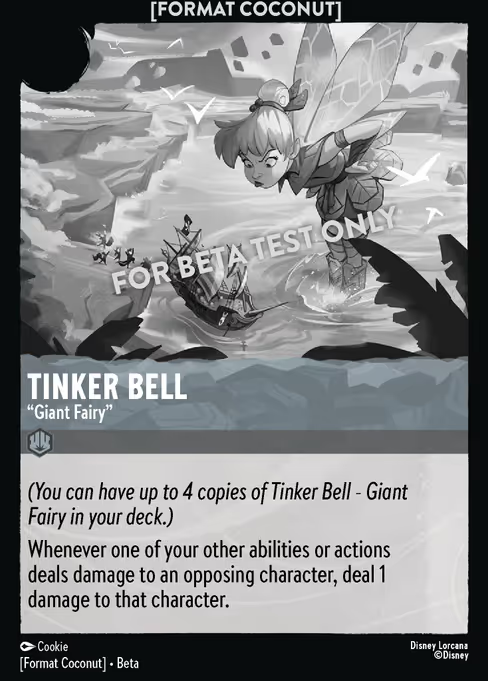
| Tinker Bell - Giant Fairy | Steel | 4 | 4 | 0 |
| Dumbo - Ninth Wonder of the Universe | Amethyst | 4 | 3 | +1 |
| Winnie the Pooh - Hunny Wizard | Amethyst | 3 | 7 | -4 |
| Snow White - Merry as the Morning | Amethyst | 3 | 4 | -1 |
| Moana - Curious Explorer | Sapphire | 3 | 3 | 0 |
| John Silver - Greedy Treasure Seeker | Steel | 2 | 3 | -1 |
| Scar - Finally King | Steel | 2 | 0 | +2 |
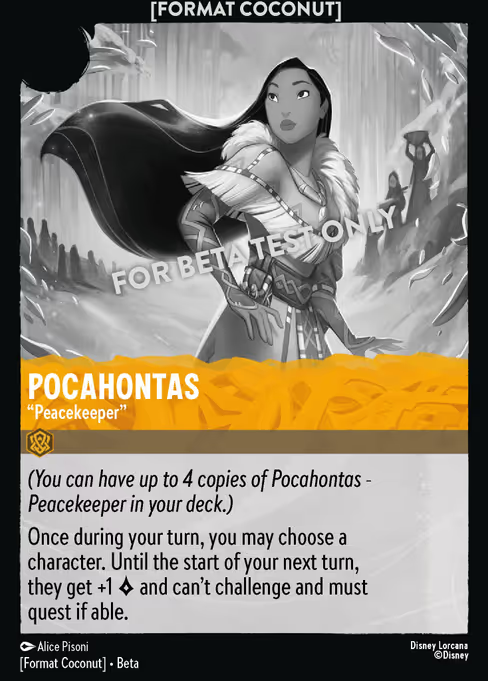
| Pocahontas - Peacekeeper | Amber | 0 | 2 | -2 |
Mr. Incredible lost the top spot. Two weeks ago it was the clear leader. It is now third, and the two Coconuts that passed it both roughly doubled.
The finding that actually matters: brewing and playing are not the same thing
Deck count tells you how many people built something. It does not tell you how many people wanted it. The library also records how many times each deck was copied by another user, and those two numbers disagree badly.
| Coconut | Decks | Copies | Copies per deck |
|---|---|---|---|
| Tinker Bell - Giant Fairy | 4 | 59 | 14.8 |
| Stitch - Rock Star | 5 | 60 | 12.0 |
| Ursula - Deceiver of All | 7 | 80 | 11.4 |
| Mr. Incredible - Super Strong | 8 | 59 | 7.4 |
| Nick Wilde - Wily Fox | 6 | 43 | 7.2 |
| Donald Duck - Fred Honeywell | 12 | 39 | 3.3 |
| Mickey Mouse - Brave Little Tailor | 5 | 14 | 2.8 |
| Mufasa - Ruler of Pride Rock | 10 | 23 | 2.3 |
| Ariel - Spectacular Singer | 5 | 10 | 2.0 |
| Robin Hood - Sneaky Sleuth | 4 | 4 | 1.0 |
| Dumbo - Ninth Wonder of the Universe | 4 | 3 | 0.8 |
| Winnie the Pooh - Hunny Wizard | 3 | 2 | 0.7 |
| Sisu - Emboldened Warrior | 5 | 2 | 0.4 |
| Snow White - Merry as the Morning | 3 | 0 | 0.0 |
Look at the top and bottom of that table against the one before it.
Donald Duck has the most decks and the sixth-most copies. Twelve people built one. Very few people wanted to play someone else’s. Mufasa - Ruler of Pride Rock is the same story, ten decks and 2.3 copies each. Sisu - Emboldened Warrior is the sharpest version: five separate people brewed it, and the entire archetype has been copied twice.
Meanwhile Tinker Bell - Giant Fairy has four decks and nearly fifteen copies each, the highest ratio in the format, and Stitch - Rock Star and Ursula - Deceiver of All are close behind.
We checked whether this is just an age effect, since older decks have had longer to accumulate copies. It is not: the correlation between a Coconut’s average deck age and its copies per deck is 0.286, which explains under a tenth of the variation. Tinker Bell in fact has the youngest decks of any leader in the top group and still leads by a distance.
The honest read: decks-brewed measures curiosity. Copies measures appeal. Donald Duck, Mufasa and Sisu are what the format’s brewers find interesting. Tinker Bell, Stitch and Ursula are what its players want to sleeve up. If you are choosing a Coconut to actually play with friends, the second list is the more useful one.
Why the risers are rising
We are not going to pretend to know win rates. But the mechanics give a reasonable explanation for each.
Donald Duck - Fred Honeywell got the biggest jump. Its Coconut reduces the cost of Boost abilities by one, which makes any Boost 1 ability free, every turn, forever. Free things get discovered.
Mufasa - Ruler of Pride Rock doubled. His EVERYTHING THE LIGHT TOUCHES readies your entire inkwell whenever he quests, which is effectively a second turn every turn. That is the kind of effect that reads as unbeatable on paper. Whether it survives the fact that he is an uninkable eight-drop who shrinks your inkwell by two when he lands is a different question, and the copy data suggests other players are not convinced.
Sisu - Emboldened Warrior went from 1 to 5, the largest proportional jump. Her SURGE OF POWER gives +1 strength for each card in opponents’ hands, and in a four-player pod with three opponents that is an enormous number on a three-cost body. The brewers found it. The copy count says nobody else has been persuaded yet, which fits a card that is still only 4 willpower and dies to every sweeper regardless of how large it gets.
Winnie the Pooh - Hunny Wizard is the notable faller, from 7 to 3.
Two leaders nobody is building
Pocahontas - Peacekeeper has zero decks in the current corpus. She had two in August. She is now the only Coconut in the format with nothing built on her at all.
Scar - Finally King has two, both created on the same day, up from zero. Scar has the deepest card pool of any Coconut in the game to work with. Ally is the largest classification in Lorcana outside the three birth origins, at 660 legal cards.
If being early somewhere appeals to you, those are the two open lanes. We wrote up what each is actually trying to do alongside the rest of its ink: Pocahontas with the Amber leaders, and Scar with the Steel leaders. The overview of all eighteen routes to every ink.
Deckbuilding norms are converging
Ink counts. 86 of 88 legal decks run the full three inks, or 97.7%. Of the two exceptions, one is a deliberate two-ink build, which is legal since the rule is “up to three.” The other is more interesting and we will come back to it.
Most common ink combinations:
| Combination | Decks |
|---|---|
| Amethyst / Ruby / Steel | 9 |
| Amethyst / Ruby / Sapphire | 8 |
| Amethyst / Emerald / Sapphire | 6 |
| Amethyst / Emerald / Ruby | 6 |
| Amber / Ruby / Sapphire | 6 |
| Amber / Amethyst / Emerald | 6 |
| Amber / Sapphire / Steel | 6 |
Amethyst appears in five of the seven most common combinations, which tracks with it holding the format’s deepest draw pool.
Deck sizes. 73 of 88 are exactly 60 cards, with a long thin tail out to 66. The format says “at least 60” with no maximum, and the community has decided that 60 is correct anyway. In a singleton format every card past 60 is a card diluting your best ones, so this is the right instinct.
The six-ink legal deck
The other ink outlier is worth its own section, because it confirms a rules question we had only settled by argument.
There is a Winnie the Pooh deck in the corpus that lists all six inks and is flagged legal. That is not a bug. Christopher Robin - Hunny Sage reads “GATHER THE PARTY: You can have other Hunny characters in your deck regardless of ink type,” and card text that modifies deck construction genuinely overrides the format’s three-ink limit.
The deck library models this exactly the way we read it: three real inks, plus an off-ink Hunny package tracked separately, still legal. If you are building Hunny and wondering whether you can run the off-ink members, the answer is yes.
That does not mean you should run all of them. Several lose on rate rather than legality, which we go through in the deckbuilding guide.
The format is growing
Of the 91 decks in the library, 17 were created in July and 74 in August. Whatever else is true, more people are building Coconut decks each week than the week before.
What we do with this
We build Coconut decks, so we read this data commercially as well as competitively, and we would rather say that out loud than pretend otherwise.
The copies-per-deck column is the one we pay attention to, because a deck other people want to copy is a deck other people want to play. It is not proof of anything. It is the best available signal in a format that does not have better ones yet, and we would rather act on a weak signal we have measured than on a strong opinion we have not.
We will re-run this every few weeks. When the numbers move, we will say so, including when they move against something we said last time.
Sources and method
The deck corpus is the public community deck library on duels.ink, filtered to Format Coconut, pulled complete on 25 August 2026 and compared against our own pull of 11 August 2026. Every card name, cost, ink and ability referenced here was checked against current Lorcana card data. Legality flags are the deck library’s own. Copy and view counts are as reported at the time of the pull.
Format Coconut is in open beta and the rules may change. This is a living report.