
Amber Format Coconut Leaders: Ariel, Pocahontas and Stitch
The three Amber Coconuts in the open beta: Ariel, Pocahontas and Stitch. What each deck wants to be, the archetypes worth trying, the honest weaknesses, and off-ink cards that support them.

Three of the eighteen Format Coconut leaders are Amber: Ariel, Pocahontas and Stitch. This page covers all three in full: what each deck actually wants to be, the archetypes worth trying, where each one falls down, and which cards outside Amber support them.
A Coconut deck plays up to three inks, and only one of them has to match your leader. Picking an Amber leader does not make you an Amber deck. It fixes one slot of three and leaves the other two open, so the useful question is never “what does Amber do” but “what does Amber still need.”
Every card, stat and ability on this page was checked against current Lorcana card data before publishing. Where a beta ruling is genuinely unclear, we say so instead of picking a side.
New to the format? Start with how Format Coconut works, then how to build a Coconut deck.
What Amber brings to a three-ink deck
Amber is the song ink. It holds 28 songs, more than any other ink in the game, and it is one of only three inks with meaningful hard removal, carrying 4 of the 29 cards that banish a chosen character.
Two of these three leaders pay you for playing cards rather than for attacking, which is what you want at a four-player table where attacking invites three retaliations.
| Ink | Songs | Items | Locations | Cards that draw | 3+ lore characters | Banish chosen character | One-sided sweepers |
|---|---|---|---|---|---|---|---|
| Amber | 28 | 28 | 13 | 37 | 20 | 4 | 0 |
| Amethyst | 20 | 32 | 13 | 74 | 19 | 1 | 0 |
| Emerald | 19 | 34 | 13 | 50 | 38 | 2 | 1 |
| Ruby | 19 | 29 | 18 | 23 | 15 | 23 | 0 |
| Sapphire | 18 | 51 | 12 | 27 | 31 | 1 | 0 |
| Steel | 17 | 34 | 16 | 56 | 24 | 0 | 10 |
Counted across every card currently legal in Infinity. “One-sided sweepers” means cards that damage every opposing character without touching your own; symmetric board damage such as Lyle Tiberius Rourke - Crystallized Mercenary is excluded. “Cards that draw” is a broad match and is best read as a ranking between inks rather than an exact total. Use this to pick the two inks you are adding, not the one your leader already picked for you.
The two rules that decide every entry below
If you have landed here directly, these are the two rules that make evaluating a Coconut different from normal deckbuilding.
- The Coconut card is not in your deck. It costs no slot, it cannot be removed, and its ability is on from turn one.
- Singleton counts full names, not characters. “A character named Stitch” is a deep well, because every version of Stitch is a different card you may run one of. “Two or more other Hunny characters in play” is a trap, because each one is a one-of that has to be drawn and then survive. When an ability cares about a name, that is good news. When it counts a classification on the board, be suspicious.
A third category is easy to confuse with the second and is actually fine: abilities that trigger when you play a card of a type need only one card at a time in hand, never density on the board.
Both are covered in full in how to build a Coconut deck.
We are deliberately not ranking these by power. The format is weeks old, not one deck in the public corpus carries a win rate, and anyone claiming to know the best deck is guessing. Read these as build briefs.
Ariel - Spectacular Singer
Whenever a Princess character of yours sings a song, gain lore equal to her ◊.
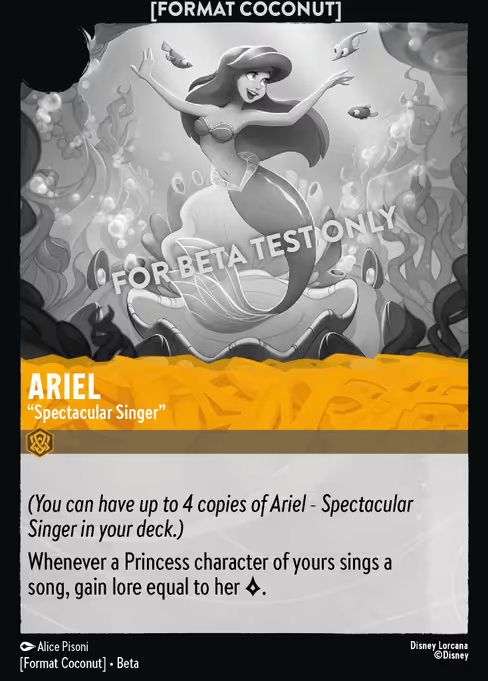
Unlocks 4x Ariel - Spectacular Singer, a 3-cost 2/3/1 inkable Storyborn Hero Princess with Singer 5, and MUSICAL DEBUT: when you play her, look at the top 4 cards of your deck, reveal a song card and put it in your hand, and put the rest on the bottom.
The deck: Princess songs. Singing a song exerts a character instead of paying its ink cost, and the Coconut turns each of those into a lore gain on top. So every song you sing is effectively free, and it also quests for you.
Archetype, Choir Practice. Load up on songs and high-lore Princesses, then chain them. Amber has the deepest song pool in the game at 28, and Ariel’s own Singer 5 lets a 3-drop sing your five-cost songs from the moment her ink is dry.
Strengths. Two resources at once: the song’s effect and the lore. In a pod where combat draws retaliation, gaining lore without attacking anyone is quietly excellent. MUSICAL DEBUT digging four cards deep for a song is real consistency in a singleton deck, and you have four copies of it.
Weaknesses. The payout is the singer’s lore, and here is the sting: across the whole legal pool there are 147 Princess cards but only ten with 3 or more lore. Realistically you are gaining 1 or 2 per song, not 3. Ariel herself has 1 lore, so she is your enabler, not your payoff. You also need a Princess and a song in hand at the same time, and a character cannot sing on the turn it is played, so the engine is always a turn behind.
Two off-ink cards worth building toward. The Coconut pays lore equal to the singer, so what you want from your other two inks is high-lore Princesses, and Amber does not have a monopoly on those. Tiana - True Princess (Emerald, 5 cost, 5/3/3) is a vanilla 3-lore Princess, the maximum payout the Coconut can give, and she is inkable. Cinderella - Stouthearted (Steel, 7 cost, 5/5/3) is another 3-lore Princess, and her SINGING SWORD lets her challenge ready characters on any turn you cast a song, so she attacks on the same turn she is paying you.
Pocahontas - Peacekeeper
Once during your turn, you may choose a character. Until the start of your next turn, they get +1 ◊ and can’t challenge and must quest if able.
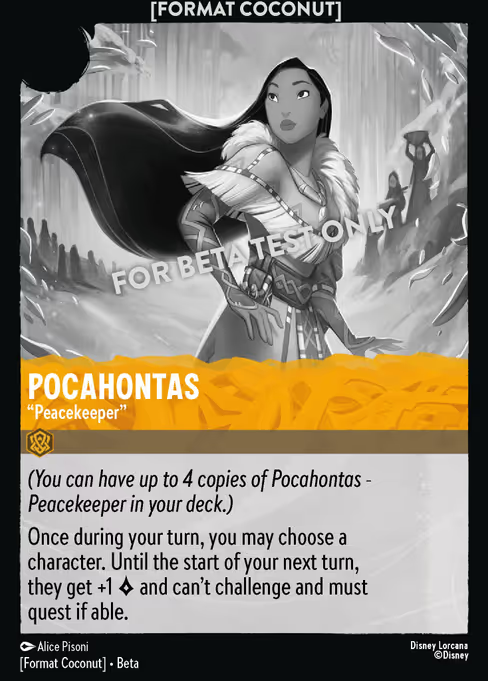
Unlocks 4x Pocahontas - Peacekeeper, a 5-cost 3/6/2 inkable Floodborn Hero Princess with Shift 3, and CALMING WORDS: when you play her, if you used Shift and none of your characters challenged this turn, characters can’t challenge until the start of your next turn.
The deck: lore control. This is the most misread Coconut in the set, because it targets any character, including an opponent’s.
Archetype one, Royal Escort. Point it at your own biggest quester every turn. A 3-lore character becomes a 4-lore character, permanently, once per turn. It cannot challenge that turn, which usually costs you nothing on a dedicated quester.
Archetype two, Peace Talks. Point it at the scariest blocker on the table. They cannot challenge, they must quest if able, and they end their turn exerted and vulnerable. You have effectively disarmed a defender and put them in the open.
Strengths. Free every turn, needs no cards, and switches between offense and defense based on the board. CALMING WORDS is a table-wide fog that stops a race dead, and it protects your board through a turn where you are tapped out.
Weaknesses. Read the offensive mode carefully before you use it: forcing an opponent’s character to quest gains them lore, and the +1 makes it worse. You are trading their blocker for their tempo, which is not always a good trade in a race to 25. CALMING WORDS also has two conditions stacked on it, Shift and no challenges this turn, and Shift needs another Pocahontas already in play.
Two off-ink cards worth building toward. You want the biggest lore numbers you can find, since the Coconut adds one to whatever it targets. Gantu - Captain Crankyhead (Steel, 5 cost, 4/3/4) is a vanilla four-lore body that becomes a five-lore quester every turn you point the Coconut at him. Simba - Scrappy Cub (Ruby, 2 cost, 1/1/3) does the same job much earlier, three lore on a two-drop and four under the Coconut, at the price of being uninkable. Watch for lore that shrinks: several high-lore characters lose lore based on cards in opponents’ hands, which is a disaster at a four-player table.
Stitch - Rock Star
Once during your turn, you may play a character with cost 2 or less from your hand for free. If you have a character named Stitch in play, you may play a character with cost 2 or less from your discard for free instead.
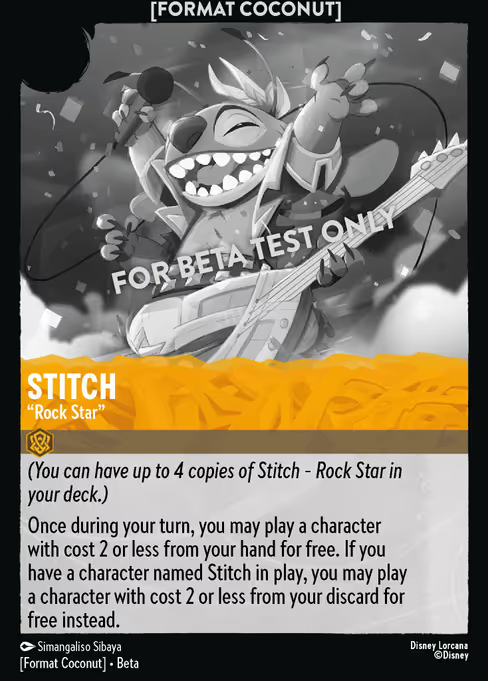
Unlocks 4x Stitch - Rock Star, a 6-cost 3/5/3 inkable Floodborn Hero Alien with Shift 4, and ADORING FANS: whenever you play a character with cost 2 or less, you may exert them to draw a card.
The deck: a free-value engine that never stops.
Archetype, Small Time. Fill the deck with cheap bodies that do something when they arrive. Every turn the Coconut plays one for free, and if Stitch - Rock Star is on the table, ADORING FANS lets you exert that free body to draw a card. A free card and a free draw, every single turn, from an ability nobody can remove.
Strengths. This is the most reliable engine in the format, because it is not gated on drawing anything. The upgrade clause keys off a character named Stitch, which is exactly the kind of name check that singleton cannot break, so any Stitch version turns it on. Recurring 2-drops from your discard makes your graveyard a second hand in the late game.
Weaknesses. Everything it gives you is small. Two-drops that are individually weak still add up to a board of individually weak things, and a single sweeper takes the whole turn’s worth of work with it. The unlocked card is a 6-cost body in a deck built around cheap ones, and Shift 4 needs another Stitch in play first.
Two off-ink cards worth building toward. The free body wants to do something when it lands, and ideally help switch on the discard clause. Simba - Future King (Steel, 1 cost) draws a card and then discards one, which is both value and the fastest way to start stocking the graveyard the upgraded Coconut plays from. The Fates - Only One Eye (Emerald, 1 cost, 2/1/1) is a free two-power body that shows you the top card of every opponent’s deck.
What people are actually building in Amber
From every public community deck in the format, pulled 25 August 2026, 88 of them legal. Decks is how many people built one. Copies taken is how many times someone else copied that deck to play it themselves. Those measure different things and they disagree loudly.
| Coconut | Decks | Copies taken | Copies per deck |
|---|---|---|---|
| Stitch - Rock Star | 5 | 60 | 12.0 |
| Ariel - Spectacular Singer | 5 | 10 | 2.0 |
| Pocahontas - Peacekeeper | 0 | 0 | n/a |
Amber is the sharpest split in the format. Stitch has the second-highest copies-per-deck of any Coconut, and Pocahontas is the only one of the eighteen that nobody has built at all. Those two sit in the same ink. If you want a leader with no established playbook to copy from, Pocahontas is the emptiest lane on the board.
None of this is a power ranking. Not one deck in the corpus carries a win rate, so nobody has performance data for this format, us included. Read the right-hand column as how much other people wanted to play it, which is useful and is a completely different thing from whether it is good.
The full eighteen-leader comparison is in the August format report.
The other five inks
Amethyst · Emerald · Ruby · Sapphire · Steel
Or start from the overview of all eighteen leaders.
Want one already built?
We are building ready-to-play Format Coconut decks now, and every list gets played out before it ships to anybody. The first wave is not on sale yet. Join the list on our Format Coconut decks page and we will email you the moment it is ready.