Amethyst Format Coconut Leaders: Dumbo, Snow White and Pooh
The three Amethyst Coconuts: Dumbo, Snow White and Winnie the Pooh. Deck plans, archetypes, weaknesses, and the off-ink cards each one needs, checked against current card data.

Three of the eighteen Format Coconut leaders are Amethyst: Dumbo, Snow White and Winnie the Pooh. This page covers all three in full: what each deck actually wants to be, the archetypes worth trying, where each one falls down, and which cards outside Amethyst support them.
A Coconut deck plays up to three inks, and only one of them has to match your leader. Picking an Amethyst leader does not make you an Amethyst deck. It fixes one slot of three and leaves the other two open, so the useful question is never “what does Amethyst do” but “what does Amethyst still need.”
Every card, stat and ability on this page was checked against current Lorcana card data before publishing. Where a beta ruling is genuinely unclear, we say so instead of picking a side.
New to the format? Start with how Format Coconut works, then how to build a Coconut deck.
What Amethyst brings to a three-ink deck
Amethyst is the draw ink, and it is not close. 74 Amethyst cards draw cards, well ahead of Steel at 56 and Emerald at 50. What it does not do is kill things: Amethyst holds exactly 1 of the 29 banish-chosen-character effects in the game.
That shortfall decides your other two inks before you have looked at a single card. An Amethyst Coconut is buying its removal somewhere else, and Ruby holds 23 of the 29 answers.
| Ink | Songs | Items | Locations | Cards that draw | 3+ lore characters | Banish chosen character | One-sided sweepers |
|---|---|---|---|---|---|---|---|
| Amber | 28 | 28 | 13 | 37 | 20 | 4 | 0 |
| Amethyst | 20 | 32 | 13 | 74 | 19 | 1 | 0 |
| Emerald | 19 | 34 | 13 | 50 | 38 | 2 | 1 |
| Ruby | 19 | 29 | 18 | 23 | 15 | 23 | 0 |
| Sapphire | 18 | 51 | 12 | 27 | 31 | 1 | 0 |
| Steel | 17 | 34 | 16 | 56 | 24 | 0 | 10 |
Counted across every card currently legal in Infinity. “One-sided sweepers” means cards that damage every opposing character without touching your own; symmetric board damage such as Lyle Tiberius Rourke - Crystallized Mercenary is excluded. “Cards that draw” is a broad match and is best read as a ranking between inks rather than an exact total. Use this to pick the two inks you are adding, not the one your leader already picked for you.
The two rules that decide every entry below
If you have landed here directly, these are the two rules that make evaluating a Coconut different from normal deckbuilding.
- The Coconut card is not in your deck. It costs no slot, it cannot be removed, and its ability is on from turn one.
- Singleton counts full names, not characters. “A character named Stitch” is a deep well, because every version of Stitch is a different card you may run one of. “Two or more other Hunny characters in play” is a trap, because each one is a one-of that has to be drawn and then survive. When an ability cares about a name, that is good news. When it counts a classification on the board, be suspicious.
A third category is easy to confuse with the second and is actually fine: abilities that trigger when you play a card of a type need only one card at a time in hand, never density on the board.
Both are covered in full in how to build a Coconut deck.
We are deliberately not ranking these by power. The format is weeks old, not one deck in the public corpus carries a win rate, and anyone claiming to know the best deck is guessing. Read these as build briefs.
Dumbo - Ninth Wonder of the Universe
You may use the ⟳ abilities of your characters the turn they’re played.
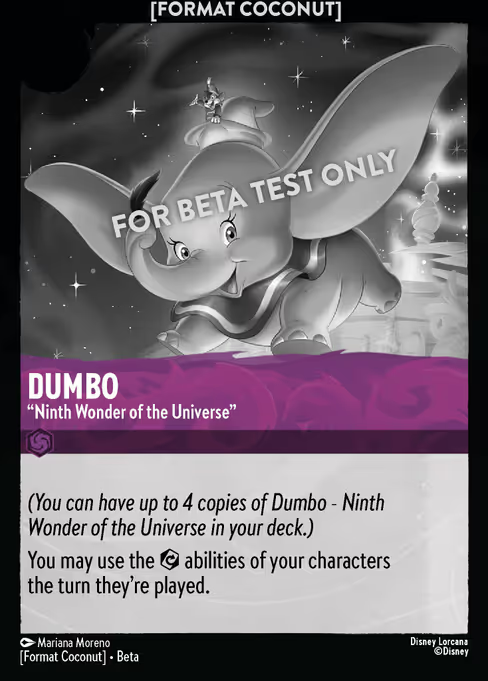
Unlocks 4x Dumbo - Ninth Wonder of the Universe, a 4-cost 3/3/1 inkable Storyborn Hero with Evasive, BREAKING RECORDS (⟳, 1 ⬡: draw a card and gain 1 lore) and MAKING HISTORY (your other characters with Evasive gain the same ability).
The deck: the cleanest engine in the format, and it is not close.
Archetype, Flight Plan. Dumbo hands every other Evasive character you control a tap ability that draws a card and gains a lore. The Coconut removes the wait. So every Evasive character you play can immediately tap for a card and a point, on the turn it arrives. There are 134 printed-Evasive characters in the legal pool, and every single one of them is in Amethyst, Emerald or Ruby. Evasive does not exist as a printed keyword anywhere else, so Dumbo effectively points you at those two inks alongside his own.
Strengths. Card and lore from the same action, repeatable, on a body that also blocks well because only Evasive characters can challenge Evasive characters. Every turn you untap and do it again. The Coconut is also broader than the Dumbo synergy alone, since it accelerates every tap ability in your deck, items included.
Weaknesses. The engine needs Dumbo - Ninth Wonder of the Universe in play, and he is a 3/3 that dies to almost anything. Without him the Coconut is just a mild accelerant. He is also the most expensive playset in the format by a wide margin, which is a real barrier if you are buying in. And tapping a character to draw means it is not questing or blocking, so the engine competes with the clock.
Two off-ink cards worth building toward. Anything with printed Evasive inherits the draw-and-gain-a-lore tap, and the Coconut removes the wait, so the cheapest Evasive bodies are the best ones. Pegasus - Gift for Hercules (Emerald, 1 cost) and Dash Parr - Dodgeball Dynamo (Ruby, 1 cost) are both one-cost Evasive characters that, with Dumbo already out, tap for a card and a point the moment they arrive.
Snow White - Merry as the Morning
Once per game during your turn, you may reveal your hand. If you have a Snow White and 7 or more Seven Dwarfs character cards with different names among the cards in your hand, in your discard, and in play, your characters get +2 ◊ for the rest of the game.
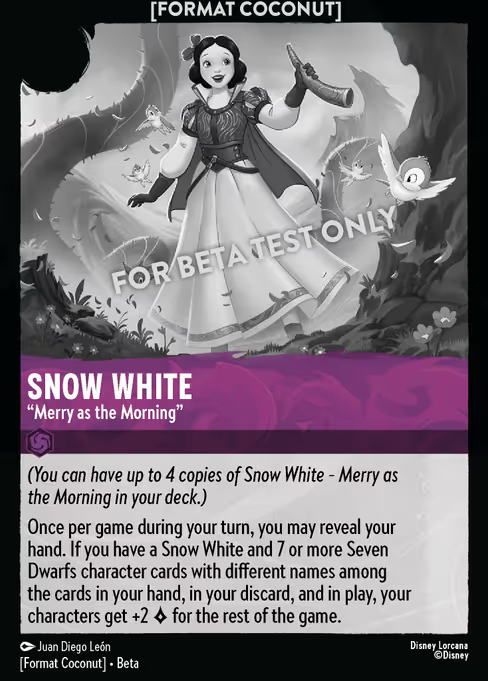
Unlocks 4x Snow White - Merry as the Morning, a 3-cost 2/3/1 inkable Dreamborn Hero Princess with CLARION CALL (whenever she quests, you may return a Seven Dwarfs character of yours to your hand to draw a card) and NEVER FORGOTTEN (during an opponent’s turn, when she is banished in a challenge, return her to your hand).
The deck: a deckbuilding puzzle with an enormous prize.
Here is the number that decides everything, and almost nobody has checked it: there are exactly seven distinct Seven Dwarfs names in the game. Bashful, Doc, Dopey, Grumpy, Happy, Sleepy and Sneezy. The Coconut asks for seven with different names, so it is asking for all of them. There is no margin.
The good news is that it counts cards in your hand, discard and play, not on the board. They never have to be alive at the same time. And every one of the seven names has a version printed in Amber, in Amethyst, and in Steel, so a two-ink slice of your deck can cover the whole set.
Archetype, Heigh-Ho. Run one version of each of the seven dwarfs, plus Snow White, and play a normal deck around them. Somewhere around turn six or seven you will have drawn or discarded enough of them to flip the switch, and then every character you control quests for two more than it says. In a race to 25, that ends the game.
Strengths. This is the one place where the format’s anti-tribal math does not apply, because zones count and boards do not. A permanent +2 lore on every character is the single biggest effect any Coconut offers. CLARION CALL also turns a dwarf into a card and puts it back in your hand, where it still counts.
Weaknesses. Eight mandatory slots, several of which are cards you would never otherwise play, in a format where every slot is contested. Miss one dwarf name and the Coconut does literally nothing all game. It is also once per game, so a mistimed reveal is gone forever.
Two off-ink cards you are not choosing, you are required to find. Because the Coconut needs all seven dwarf names and there are only seven in existence, off-ink dwarfs are mandatory rather than optional. Sneezy - Very Allergic (Amber, 2 cost) and Happy - Lively Knight (Steel, 1 cost) are two of the seven, sitting in two different inks. Every dwarf name in the game appears somewhere in Amber, Amethyst and Steel, so those three inks together always cover the full set.
Winnie the Pooh - Hunny Wizard
Whenever you play a character without an ability, you may pay 1 ⬡ to draw a card.
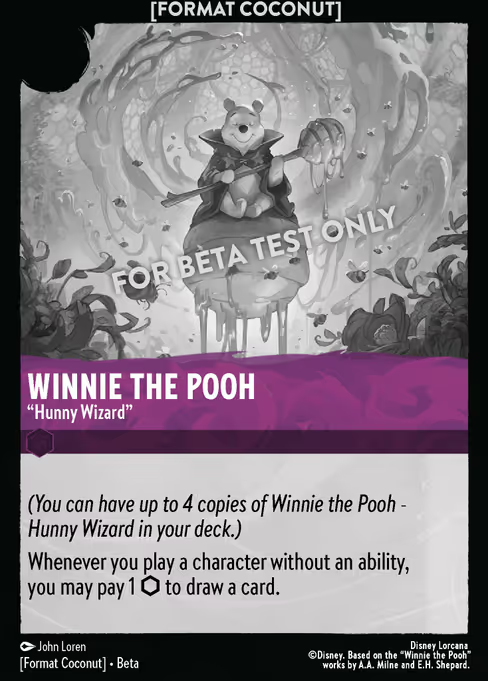
Unlocks 4x Winnie the Pooh - Hunny Wizard, a 5-cost 5/5/2 inkable Dreamborn Hero Sorcerer with no rules text at all, which means the card triggers its own Coconut.
The deck: vanilla beatdown that draws its way to 25.
Archetype, Hundred Acre Wood. Fill the deck with plain characters, the ones with no abilities that never make a constructed deck, and treat every one of them as a body plus a card. We built this deck and modelled it: the Coconut fired five to six times over ten turns and accounted for roughly 68% of the deck’s card throughput. It is the engine, not a bonus.
Strengths. The cheapest deck in the format to assemble, because vanilla characters are the cards nobody wants. The engine has no setup, no key card, and nothing to remove. Big vanilla finishers do double duty, closing the game while triggering the draw.
Weaknesses. One ink per card adds up fast, and on a turn where you want to develop, the draws compete with your plays. Vanilla characters do nothing but attack and quest, so you have no interaction unless you spend non-vanilla slots on it, which turns the engine off. And a deck of plain bodies has no answer to a board wipe beyond rebuilding.
Two off-ink cards worth building toward. The Coconut converts plain characters into cards, and the plainest characters in the game are not in Amethyst. Goofy - Knight for a Day (Steel, 9 cost, 10/10/4) is a vanilla ten-power body that draws you a card on the way down. Robin Hood - Daydreamer (Emerald, 6 cost, 4/5/4) is a four-lore vanilla, which is a rare thing: a card that closes the game, triggers the engine, and has no text to get in the way.
What people are actually building in Amethyst
From every public community deck in the format, pulled 25 August 2026, 88 of them legal. Decks is how many people built one. Copies taken is how many times someone else copied that deck to play it themselves. Those measure different things and they disagree loudly.
| Coconut | Decks | Copies taken | Copies per deck |
|---|---|---|---|
| Dumbo - Ninth Wonder of the Universe | 4 | 3 | 0.8 |
| Winnie the Pooh - Hunny Wizard | 3 | 2 | 0.7 |
| Snow White - Merry as the Morning | 3 | 0 | 0.0 |
Amethyst is the least-copied ink in the format. Ten decks built between the three leaders, five copies taken between them, and Snow White has never been copied once. That is not evidence the leaders are weak, because no deck in this format carries a win rate. It is evidence that almost nobody has tried them.
None of this is a power ranking. Not one deck in the corpus carries a win rate, so nobody has performance data for this format, us included. Read the right-hand column as how much other people wanted to play it, which is useful and is a completely different thing from whether it is good.
The full eighteen-leader comparison is in the August format report.
The other five inks
Amber · Emerald · Ruby · Sapphire · Steel
Or start from the overview of all eighteen leaders.
Want one already built?
We are building ready-to-play Format Coconut decks now, and every list gets played out before it ships to anybody. The first wave is not on sale yet. Join the list on our Format Coconut decks page and we will email you the moment it is ready.