
Sapphire Format Coconut Leaders: Moana, Mufasa and Nick Wilde
The three Sapphire Coconuts: Moana, Mufasa and Nick Wilde. What each deck wants, the archetypes, the weaknesses, and complementary off-ink cards.

Three of the eighteen Format Coconut leaders are Sapphire: Moana, Mufasa and Nick Wilde. This page covers all three in full: what each deck actually wants to be, the archetypes worth trying, where each one falls down, and which cards outside Sapphire support them.
A Coconut deck plays up to three inks, and only one of them has to match your leader. Picking an Sapphire leader does not make you an Sapphire deck. It fixes one slot of three and leaves the other two open, so the useful question is never “what does Sapphire do” but “what does Sapphire still need.”
Every card, stat and ability on this page was checked against current Lorcana card data before publishing. Where a beta ruling is genuinely unclear, we say so instead of picking a side.
New to the format? Start with how Format Coconut works, then how to build a Coconut deck.
What Sapphire brings to a three-ink deck
Sapphire is the item ink by a distance: 51 items, half again as many as the next ink. It also has the second-deepest pool of high-lore characters at 31 and, like Amethyst, effectively no hard removal, holding 1 of the 29 banish effects.
Two of these three leaders are built directly on that item depth or on ramping past it, so Sapphire is one of the few inks where the leader and the ink genuinely point the same way.
| Ink | Songs | Items | Locations | Cards that draw | 3+ lore characters | Banish chosen character | One-sided sweepers |
|---|---|---|---|---|---|---|---|
| Amber | 28 | 28 | 13 | 37 | 20 | 4 | 0 |
| Amethyst | 20 | 32 | 13 | 74 | 19 | 1 | 0 |
| Emerald | 19 | 34 | 13 | 50 | 38 | 2 | 1 |
| Ruby | 19 | 29 | 18 | 23 | 15 | 23 | 0 |
| Sapphire | 18 | 51 | 12 | 27 | 31 | 1 | 0 |
| Steel | 17 | 34 | 16 | 56 | 24 | 0 | 10 |
Counted across every card currently legal in Infinity. “One-sided sweepers” means cards that damage every opposing character without touching your own; symmetric board damage such as Lyle Tiberius Rourke - Crystallized Mercenary is excluded. “Cards that draw” is a broad match and is best read as a ranking between inks rather than an exact total. Use this to pick the two inks you are adding, not the one your leader already picked for you.
The two rules that decide every entry below
If you have landed here directly, these are the two rules that make evaluating a Coconut different from normal deckbuilding.
- The Coconut card is not in your deck. It costs no slot, it cannot be removed, and its ability is on from turn one.
- Singleton counts full names, not characters. “A character named Stitch” is a deep well, because every version of Stitch is a different card you may run one of. “Two or more other Hunny characters in play” is a trap, because each one is a one-of that has to be drawn and then survive. When an ability cares about a name, that is good news. When it counts a classification on the board, be suspicious.
A third category is easy to confuse with the second and is actually fine: abilities that trigger when you play a card of a type need only one card at a time in hand, never density on the board.
Both are covered in full in how to build a Coconut deck.
We are deliberately not ranking these by power. The format is weeks old, not one deck in the public corpus carries a win rate, and anyone claiming to know the best deck is guessing. Read these as build briefs.
Moana - Curious Explorer
During your turn, if you have a Moana, Heihei, or Pua character in play, you may ink an additional card.
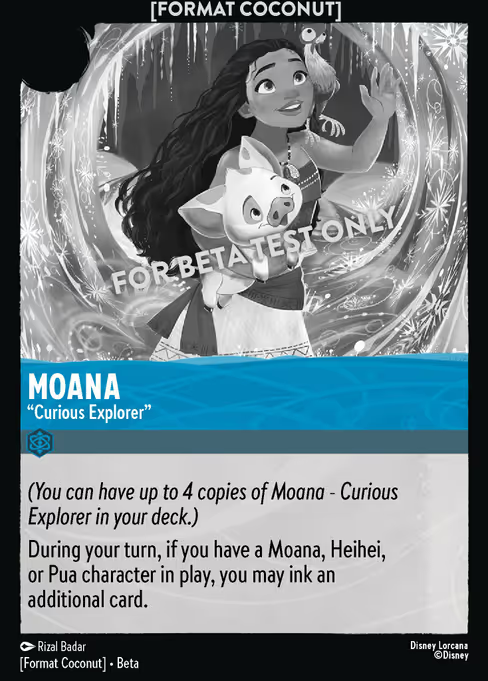
Unlocks 4x Moana - Curious Explorer, a 5-cost 4/4/2 inkable Storyborn Hero Princess with ANCESTRAL LEGACY: you can ink cards from your discard.
The deck: the only genuine ramp deck in the format.
Archetype, Wayfinding. The two pieces stack into something better than either. The Coconut gives you a second ink drop per turn, and the unlocked card lets that second drop come out of your discard instead of costing a card from your hand. Ramp without card disadvantage is rare.
The condition is a name check on Moana, Heihei or Pua, which singleton cannot shrink. There are 13 such cards, and cheap ones exist: Pua - Disgruntled Pig is a 1-cost Amethyst vanilla, and Moana - Self-Taught Sailor is a 1-cost in Ruby, so a one-drop can switch your ramp on for the rest of the game.
Strengths. Two ink a turn compounds hard over the long games this format produces, and it lets you play the expensive cards that a 25-lore race actually rewards. Inking from the discard turns your dead cards into resources.
Weaknesses. Ramp is only as good as what you ramp into, and a singleton deck cannot guarantee it draws the expensive payoff. Moana - Curious Explorer herself costs 5, so she is not your early enabler, and the discard clause needs a discard to work from, which means it does nothing on turn three. Kill the one-drop and the extra ink stops.
Two off-ink cards worth building toward. The extra ink drop needs a Moana, Heihei or Pua in play, and it is a name check, so the cheapest one you can find is the best one. Pua - Disgruntled Pig (Amethyst, 1 cost) is a vanilla one-drop, and Moana - Self-Taught Sailor (Ruby, 1 cost, 3/2/1) is a one-drop with three power. Either turns your ramp on from turn one, which matters far more than what the body does afterwards.
Mufasa - Ruler of Pride Rock
Once per game during your turn, you may pay 5 ⬡ to put the top 3 cards of your deck into your inkwell facedown and exerted.
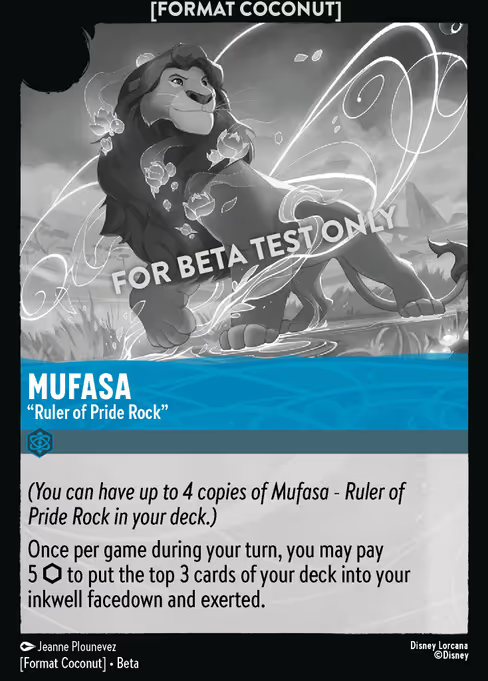
Unlocks 4x Mufasa - Ruler of Pride Rock, an 8-cost 4/9/4 uninkable Legendary Storyborn Mentor King with A DELICATE BALANCE (when you play him, exert all cards in your inkwell, then return 2 cards at random from your inkwell to your hand) and EVERYTHING THE LIGHT TOUCHES (whenever he quests, ready all cards in your inkwell).
The deck: double ink, with a real cost attached.
Archetype, Pride Rock. The payoff is EVERYTHING THE LIGHT TOUCHES. Quest with Mufasa, ready your entire inkwell, and play a second full turn of cards. He is a 4/9/4, so he quests for four while doing it. Once he sticks, every turn is two turns.
Strengths. A 9-willpower body is genuinely hard to remove through damage, and 4 lore is a fast clock in its own right. The Coconut’s once-per-game ramp exists specifically to get you to an uninkable 8-drop, and 3 permanent ink for a one-time payment of 5 is a good rate in a long game.
Weaknesses. Read A DELICATE BALANCE again, because it is a real cost, not flavour: playing him exerts your whole inkwell and then shrinks it by two. You land your best card, and your next turn is worse than your last one. He is uninkable, so he clogs your opening hand, and 8 cost in a singleton deck means you may simply never draw him. The Coconut is also once per game, and paying 5 to get 3 exerted is a net loss on the turn you do it.
Two off-ink cards worth building toward. Both halves of this deck put cards into your inkwell, so cards that trigger on that are the real payoff. Lyle Tiberius Rourke - Crystallized Mercenary (Ruby, 8 cost, 6/4/3) deals 2 damage to each character in play once a turn whenever a card enters your inkwell, which is symmetric and needs your board built to survive it. Daisy Duck - Multitalented Pirate (Emerald, 8 cost, 6/5/3) bounces an opposing character instead, which is one-sided but uninkable.
Nick Wilde - Wily Fox
You can have up to 4 copies of an item card named Pawpsicle in your deck. Once during your turn, you may banish 4 of your items. If you do, gain 4 lore.
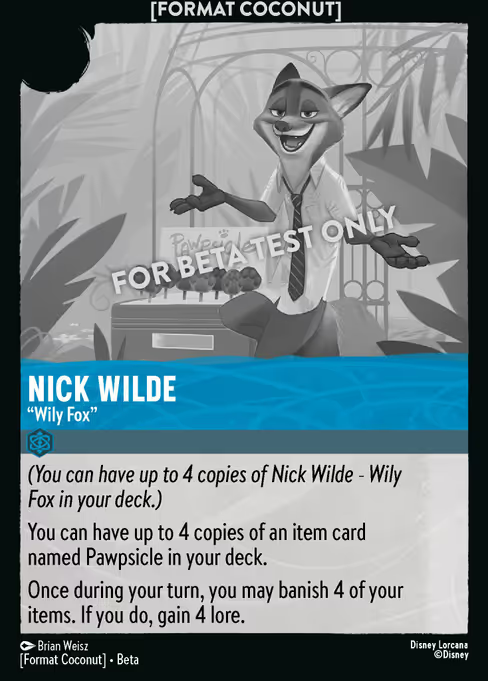
Unlocks 4x Nick Wilde - Wily Fox, a 4-cost 2/4/2 inkable Storyborn Ally with IT’S CALLED A HUSTLE: when you play him, you may return an item card named Pawpsicle from your discard to your hand.
And 4x Pawpsicle, a 1-cost inkable Sapphire item with JUMBO POP (when you play this item, you may draw a card) and THAT’S REDWOOD (banish this item: remove up to 2 damage from chosen character).
The deck: the only Coconut that turns objects directly into victory, and the only one that grants two playsets.
Archetype, The Hustle. Four lore a turn is a seven-turn clock to 25 with no combat at all. In a format where attacking marks you as the threat and invites three players to respond, a deck that wins without ever swinging is a genuinely different plan, not just a cute one.
Pawpsicle is close to a perfect engine piece here: it costs 1, it is inkable, it draws a card when it lands so it replaces itself, and it is fodder for the Coconut. Nick then returns one from your discard every time you play him.
Strengths. A clock nobody can interact with, since items are much harder to remove than characters in most decks. The item pool is deep, with over 110 items legal in a Sapphire three-ink build and more than 60 of them costing 2 or less. Your deck is also cheap, because items are not chase cards.
Weaknesses. You need four items in play at once, every single turn you want to fire, and singleton means only Pawpsicle can be stacked. That is a real density requirement, and turns where you have three items are turns where the Coconut does nothing. Item decks also tend to have thin boards, so you are relying on nobody deciding to attack you, and a 2/4 Nick does not defend anything.
Two off-ink cards worth building toward. You need four items in play every turn you want to fire, so cheap items that replace themselves are worth more than expensive ones that do more. Fortisphere (Steel, 1 cost) draws a card when you play it and can be banished to hand out Bodyguard, so it is fodder that pays for itself twice. Magic Mirror (Amethyst, 2 cost) is a repeatable draw, though it is uninkable and the draw costs four ink.
What people are actually building in Sapphire
From every public community deck in the format, pulled 25 August 2026, 88 of them legal. Decks is how many people built one. Copies taken is how many times someone else copied that deck to play it themselves. Those measure different things and they disagree loudly.
| Coconut | Decks | Copies taken | Copies per deck |
|---|---|---|---|
| Nick Wilde - Wily Fox | 6 | 43 | 7.2 |
| Mufasa - Ruler of Pride Rock | 10 | 23 | 2.3 |
| Moana - Curious Explorer | 3 | 5 | 1.7 |
Mufasa has the second-most decks of any Coconut but only the seventh-most copies, which is the signature of a leader people enjoy building more than playing. Nick Wilde is the reverse: fewer builders, far more people taking the list to a table.
None of this is a power ranking. Not one deck in the corpus carries a win rate, so nobody has performance data for this format, us included. Read the right-hand column as how much other people wanted to play it, which is useful and is a completely different thing from whether it is good.
The full eighteen-leader comparison is in the August format report.
The other five inks
Amber · Amethyst · Emerald · Ruby · Steel
Or start from the overview of all eighteen leaders.
Want one already built?
We are building ready-to-play Format Coconut decks now, and every list gets played out before it ships to anybody. The first wave is not on sale yet. Join the list on our Format Coconut decks page and we will email you the moment it is ready.